Down the Chesapeake

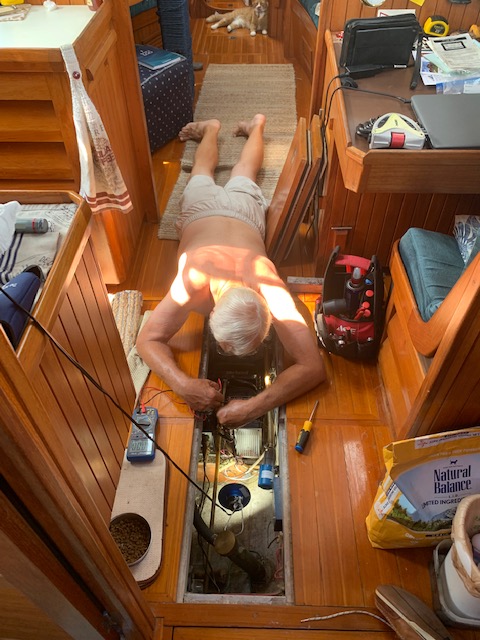
We got an early morning start out of Back Creek in Annapolis, heading south to Solomons Island, MD.  There was actually a light coat of frost on the deck when we left – brrr!  We had motored about an hour when Fred noticed that the engine had quit charging – again! Really?!?  We had just spent a lot of time and money fixing this very issue, or so we thought. Fred dove into the engine and found the alternator belt completely shredded, laying in the bottom of the engine compartment! He quickly installed our spare belt, then called Andy, our engine repair guy. Everything else seemed okay, and we decided since it was the old belt, it had met its natural end of life. All else seemed correct, so we carried on.

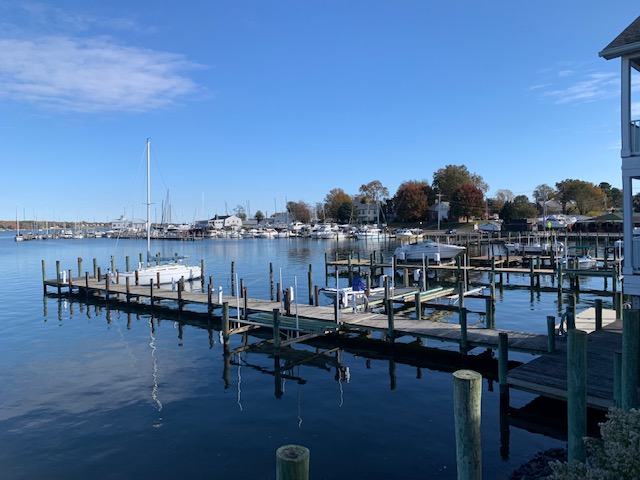
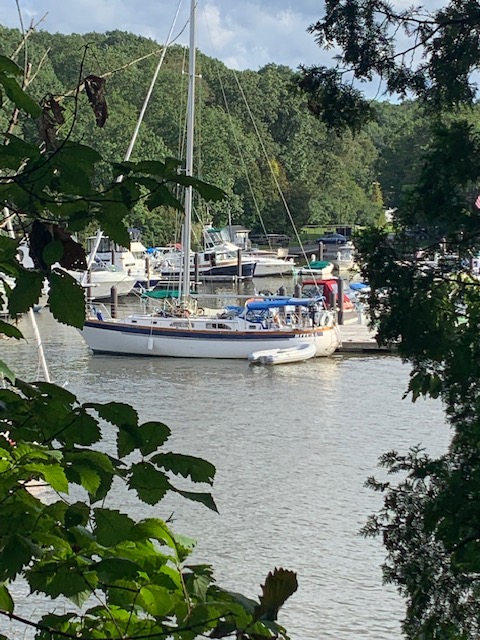
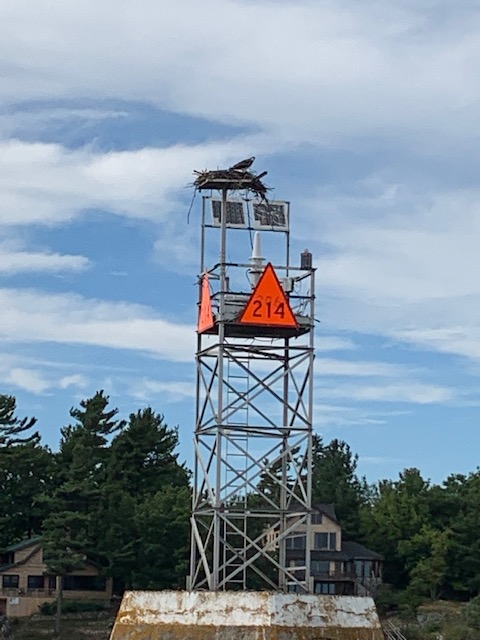
As we got close to Solomons, we passed a huge CNG (Compressed Natural Gas) ship loading from a pipeline off the shore.  Security was evident, and we cautiously passed all the “restricted area” markers. The Solomons Island harbor area is actually about 5 miles inland, up a creek. This is typical of Chesapeake harbors – off the main bay and up a more protected creek.  We motored into Back Creek (yeah – not such an original name!) to an anchorage area, and dropped the hook next to a big catamaran, which was kind of hogging the middle. The wind was projected to build and temps were falling into the 30’s, so we planned to take a slip the next day. When we woke up the next morning, the Cat was gone, but our deck was speckled with mud – probably from them hosing off their anchor!  As the wind veered, we may have been close to their anchor – we assume it was their parting shot. (side bar – we are comfortable that when we set our anchor we have plenty of swing room, after years of very crowded anchorages in Puget Sound, but sh#t happens).

We spent 2 nights at a very nice marina, enjoying heat on 35 degree nights as we were “plugged in” and waiting for another engine part to arrive. (We could run the heater from the generator if we are anchored, but the generator is loud, sucks gasoline, and stinks up the cockpit. With flannel sheets and a down comforter, we do not get cold in bed, but dressing on these frigid mornings is a race to see how many layers one can don very quickly!) The engine part ended up in Traverse City by mistake – a bummer, since it was actually only 90 minutes away by car!  It finally arrived.
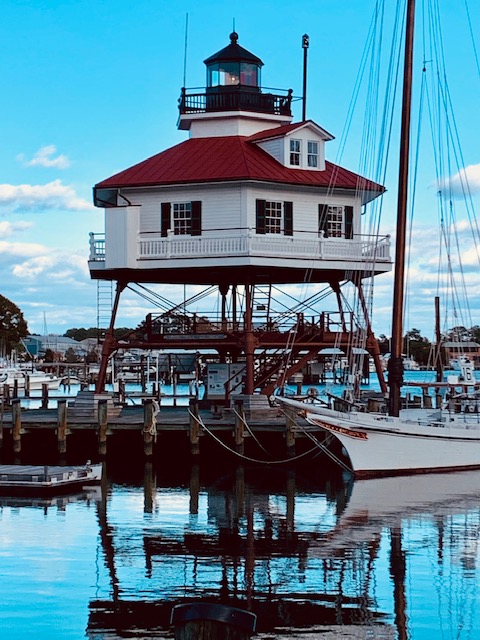
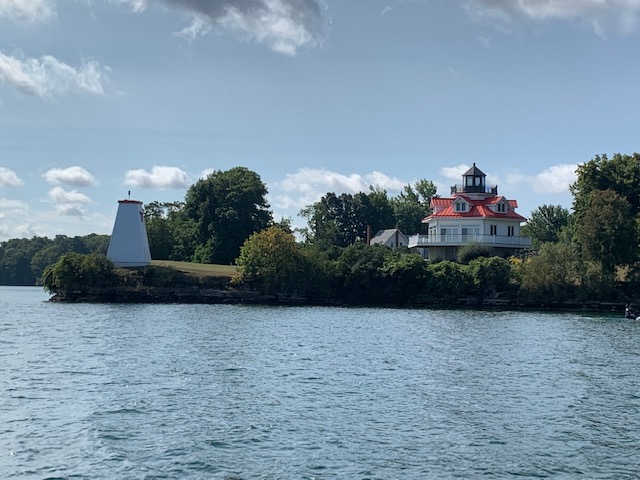
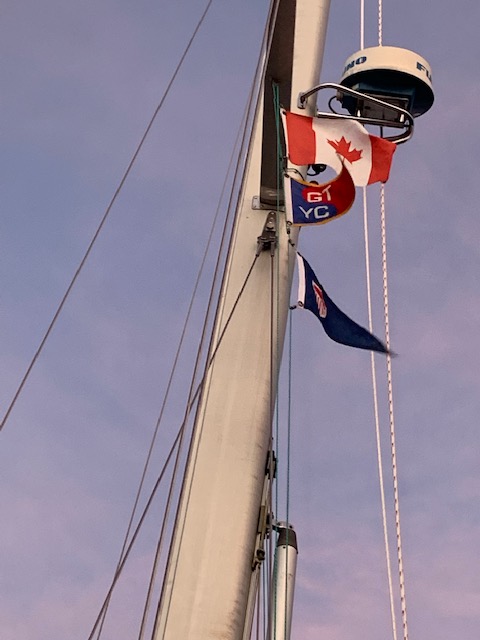
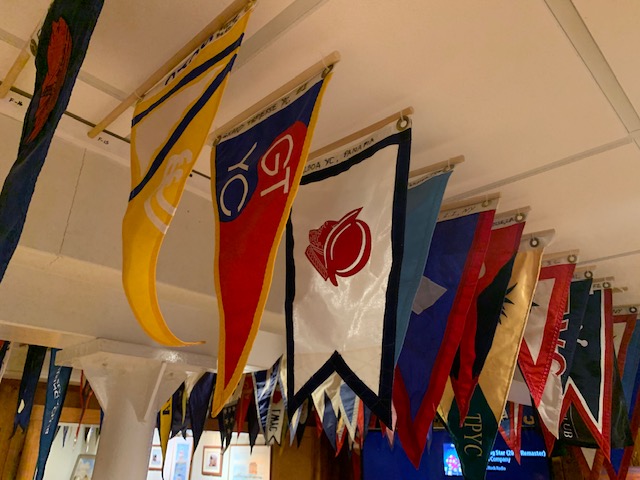
There is a wonderful Chesapeake museum here which includes the original screwpile lighthouse from Drum Point (so named because the iron legs were screwed into the ocean bottom), as well as a lot of history of the area, and also featured otters and fish and other sea-dwelling creatures. We met an interesting younger couple on a Catalina 30 who had left Philadelphia and were on their new adventure, heading to Florida. And found a sister ship (Slocum 43) at the docks, but missing from our group database. We moved to the Solomons Island Yacht Club for the next few nights – a bit less expensive, and we were treated as long lost friends. We even found the GTYC burgee hanging in the clubhouse (Kismet?)  We were included in the taco/fish dinner night, and it was a good place to ride out the big winds before finally departing.

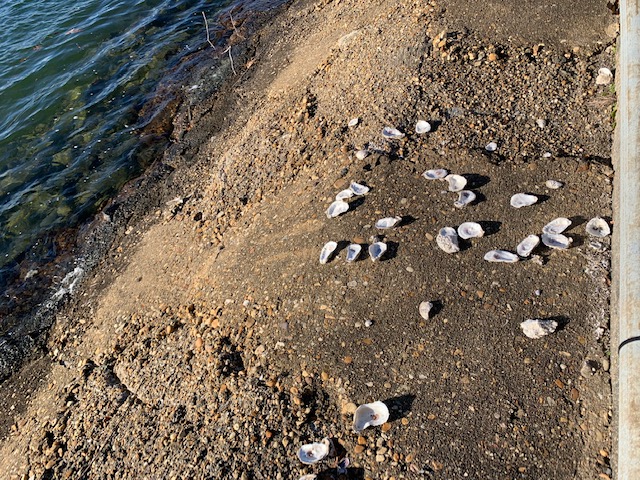
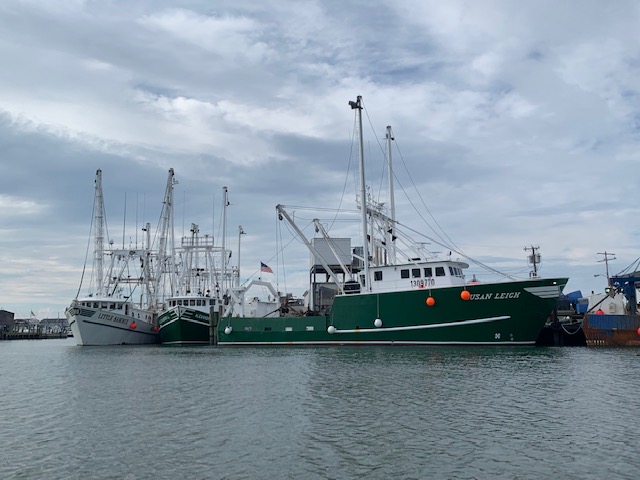
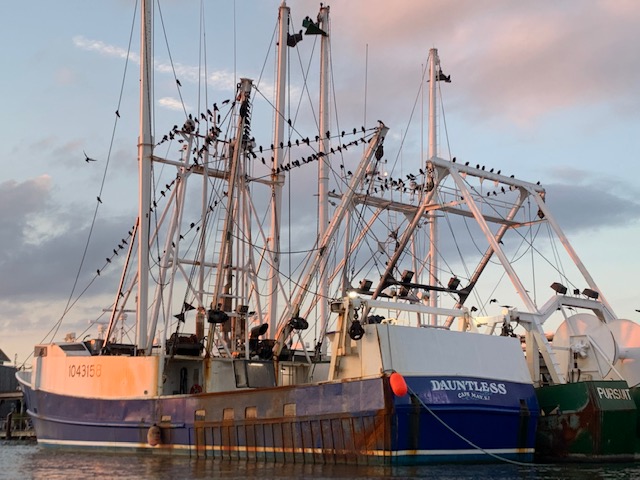
Belatedly we headed south toward Deltaville, with an overnight anchorage in Cockrell Creek. We anchored just south of the last menhaden fish processing plant in this area, and its fleet of big boats. Menhaden are a type of herring, integral to the Chesapeake food chain and used for nutritional supplements, food additives and feed for livestock and fish farms. Although not endangered, many of the plants have closed, and this one is owned by a Canadian company. Fortunately, the rumored “smell” was not detected.  The shores of this bay at low tide were littered with oysters – it was tempting to pick them, but not knowing the environment or regulations, we let them be. We also saw our first pelicans here – they really do look like mini pterodactyls as they fly by!
We had been looking forward to visiting the Deltaville Yacht Club, since fellow GTYC members have been here before us. We maneuvered through the shallow channel and anchored in Jackson Creek, but were sorry to find that the club was undergoing a major dock construction project and had no space for us, nor was the building open for services. We were in a great spot for the forecasted 20 kt north winds, but the next day we decided to go around to Fishing Bay Marina for a slip in order to have shore power for the 30 degree night and be out of the winds. It was worth the 5-mile trek around the point to the marina, and we ended up staying 2 nights, especially since they offered a courtesy car to town.  We also picked up one more engine part – for now! We can certainly see how all these spots would be very attractive when the weather is warm – pools, beach access, etc!

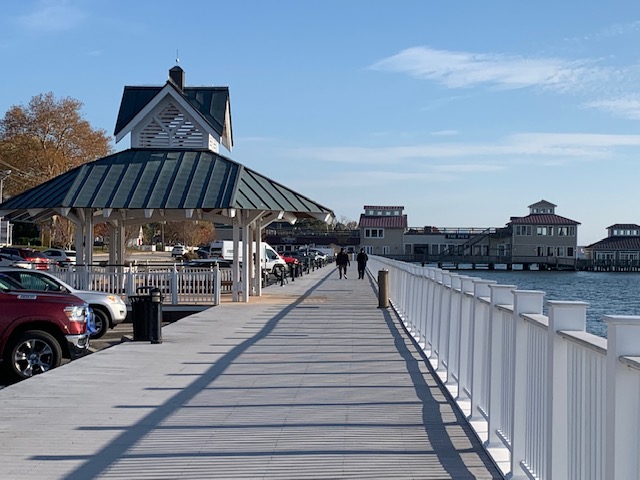
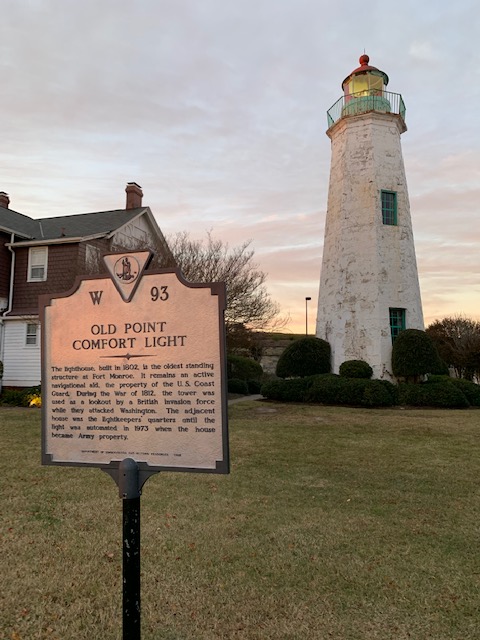
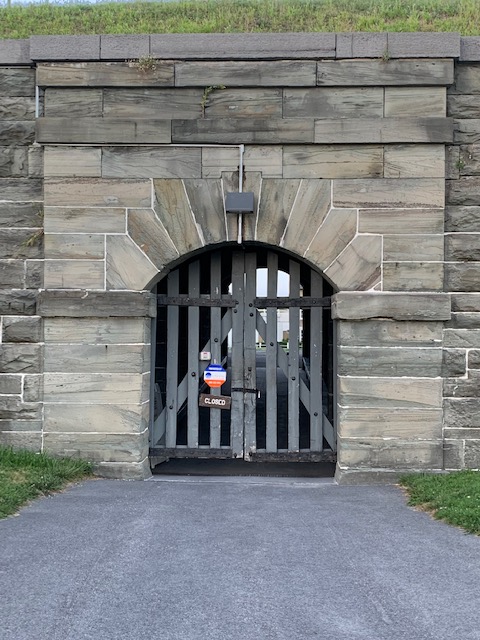
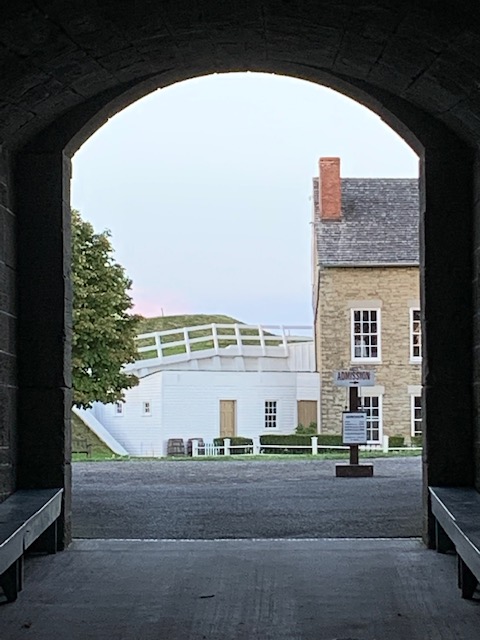
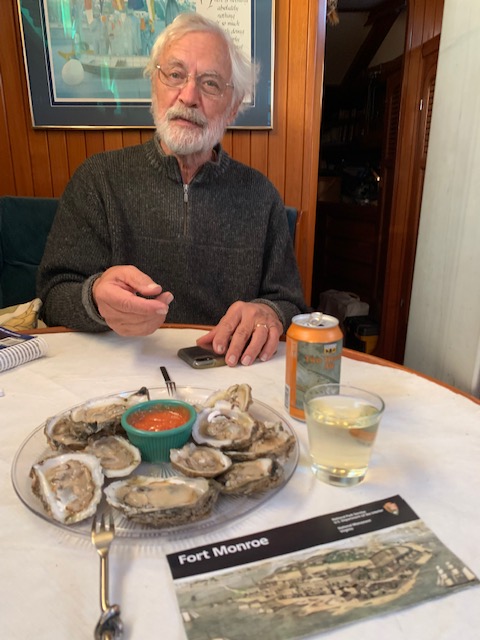
From Deltaville we headed to Hampton, VA – our last Chesapeake port before entering the Intracoastal Waterway (ICW).  We were excited to spot our first porpoise as we left Fishing Bay, and our first dolphins as we got closer to Hampton. It was a lumpy ride but the following seas slowly laid as the wind died down throughout the day. We headed for Old Point Comfort Marina – it is on the north side of the James River, across from the Norfolk area where we would enter the ICW.  It is also adjacent to Fort Monroe, one of the earliest forts built to protect this area in 1861, right before the Civil War.  Also known as the Freedom Fortress, many southern slaves found sanctuary here. The earliest fort on this site was established in 1609 by Capt. John Smith and the Virginia Company. The fort was deactivated in 2011 and is now a National Monument run by the National Park Service.  It is also the only fort we have seen with a moat!

Fellow Slocum owners Tom and Ilse (Serenata) live here, and we were so happy to have dinner with them, and then spend Thanksgiving Day with them and several of their friends. Again our cruising family extended their incredible hospitality!  They also drove us on several errands, and we visited their boat to see some of the projects they have completed. We were able to walk Fort Monroe and a bit of beach before the sunset on Friday, and were off the dock Saturday morning to cross the James River to Norfolk and enter the ICW.

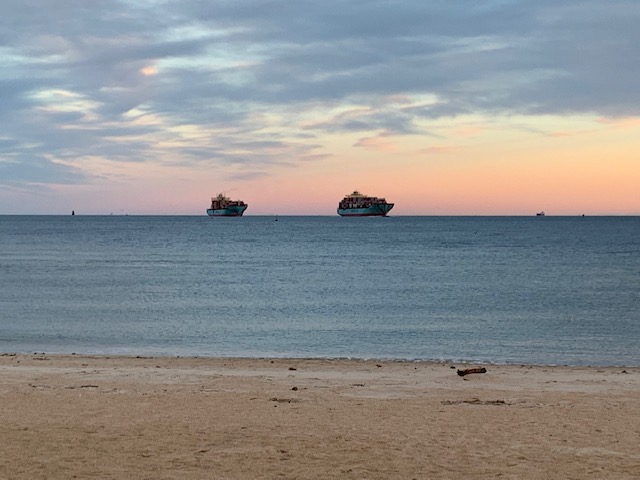
[At this point in our journey we have been asked by numerous people – how do we find living on a boat?  We have met many couples on many boats and that seems a considered choice depending on the couple.  In the beginning we tried hard to find a boat that would accommodate our “comfort levels”.  Ritual does.  She’s large enough for us to easily move around on and yet compact enough to feel safe, even in big seas.  And life has a habit of flowing into a pace and, yes, ritual that is both comfortable and reinforcing.

While “fixing the boat in exotic places” is not Fred’s most treasured time, it’s not that much different than our home on land – just more immediate.  You can’t afford to let things linger.  Our project list changes daily but seldom grows smaller.  And the down time waiting for weather and/or parts affords more opportunities than we would like to complete the tasks.

What we have come to really appreciate is the ever-present boating community that surrounds us every day wherever we are.  We appreciate and miss our friends and neighbors from home.  And we have found the new “neighbors” to be interesting and generous people.  It enriches us and renews us that all of us, regardless of background and persuasion, just want to be helpful and kind.]

Fair winds, Fred and Lisa
Annapolis!

(Note – you can click on the photos for better viewing. We are not great photographers, but the thumbnails don’t always show the entire picture).

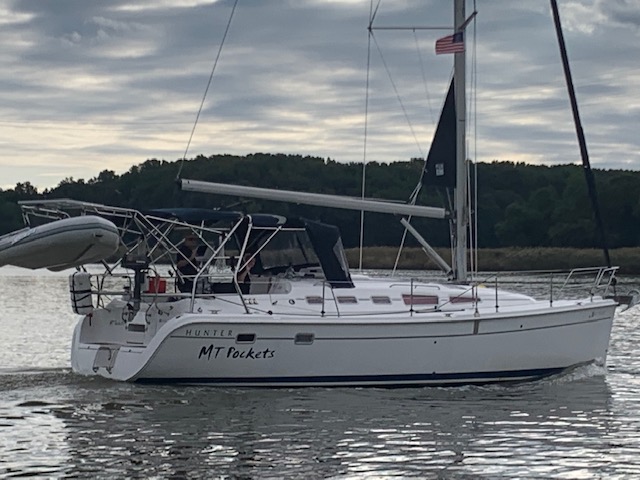
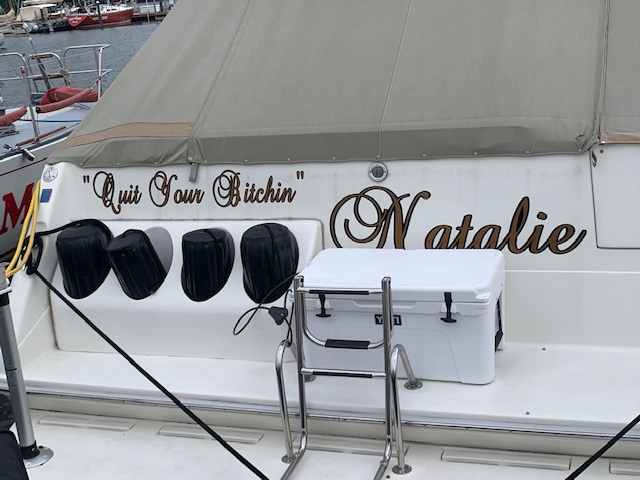
Before we exited the C and D Canal, we spent the night on the wall at Schaefer’s Canal House. Our buddy boat, MT Pockets, joined us for dinner on the balcony. For cruisers, it is typical to be called by your boat name. Not only is it easier to remember than individual’s names, but it is what you recognize when you pull into an anchorage, and also what you hear when folks are calling on the radio. It is why we chose to transfer our boat name from the old boat to the current boat (carefully following all Neptune’s formalities about renaming a boat). After 25+ years, we are “Ritual”!

On the balcony we found the people who had shouted to us about Traverse City as we tied up. Turned out the man was a former Michigander, who now lived on a point just around the corner from the end of the canal.  It seems that people are usually trying to connect somehow, and it is amazing how the six degrees of separation ring true and make the world feel just a little smaller.

In the morning we left on the receding tide – joining a parade of boats heading into the Chesapeake Bay.  We followed the marked channel, in part because there were no crab pots inside the channel, and in part because it shoaled so quickly on either side. The only annoyance was the large power boats passing us at full speed and throwing huge wakes. We try to turn into the wave to keep from being rolled side-to-side, but if they pass too close, it is hard to do so. One 90 footer blew by our fleet of 10 sailboats, eliciting cries on the radio (and a few forbidden expletives!). They did not answer and never looked back to see that they had almost swamped a couple of the smaller boats.

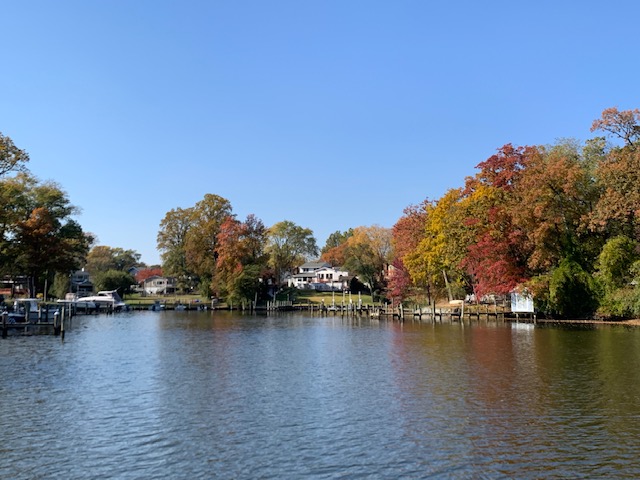
We opted for an overnight on Worton Creek since it was halfway to Annapolis and nicely sheltered from the northeast winds that were forecast to build.  The definition of creek changes again in the Chesapeake.  If you look at a map of the bay you will see a multitude of different, lacey and squiggly inlets lining both the western and eastern shores. The wider inlets are called rivers. The numerous little inlets running into each river are creeks. For example – Annapolis is off the Severn River, on Spa Creek. We are currently at a marina south of there on Back Creek. According to Google there are 150 major rivers and streams, and more than 100,000 smaller tributaries within the Chesapeake Bay watershed.

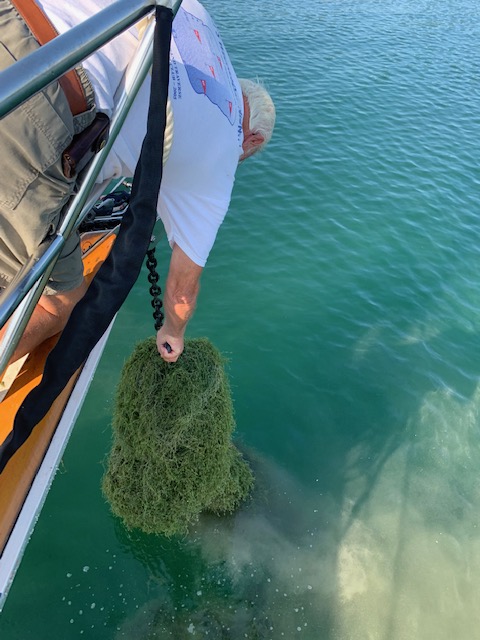
As we left the channel for our anchorage, we quickly discovered the rumored proliferation of crab traps! We ran a literal gauntlet of small red or black or orange buoys. It took one of us on the rail spotting and directing in order to avoid running over a trap. One rope from a trap, wrapped around the prop, would render our boat dead in the water.  We had considered adding a line cutter to our shaft when Ritual was out of the water, and now, in hindsight, think that would have been a prudent addition! We managed to arrive at the anchorage area without dragging any crab traps along, and joined five other boats. Further up the creek were two marinas and a “hurricane hole” – an area completely protected from all wind directions and not likely to get a big surge of water in a storm. There was supposed to be a good restaurant here, but it was closed, perhaps permanently, a fallout from covid. We stayed two nights, enjoying the serenity, eagles, herons and little beach. We needed to head for Annapolis soon, as our batteries were still not charging properly from the engine (although the solar panels help enormously!), and we also wanted to attend the first day of the U.S. Sailboat Show.

We had hoped to join a fellow Traverse City boat, Manitou, on Weems Creek near Annapolis, but decided to find a slip so we could plug into shorepower and properly charge our systems. With the Annapolis Boat Shows underway, we were very lucky to secure a slip at Jabin’s Yacht Yard on Back Creek. We thought we would be able to address our engine issues here since the yard is home to many marine businesses. We could also use some help with electronics installations and mounting our Monitor self-steering system, so we figured we were in the perfect spot.  The joke was on us however, as company after company said they were so busy that it would be sometime into November before they could fit us in! (It was October 11th).  Finally, through a fellow Slocum owner, we learned of a company in Virginia that has parts for our old engine, and they referred us to a guy here in Annapolis who works on Perkins engines (a rare breed these days). Andy agreed to take a look, and we were elated when he assured us we did not need a new engine (several of our sister boats have repowered, to the tune of 10-20 thousand bucks); second, that he would do the work; AND third, help with the electronics! And he could start right after the boat show. We are still trying to find someone to help mount the monitor wind vane.

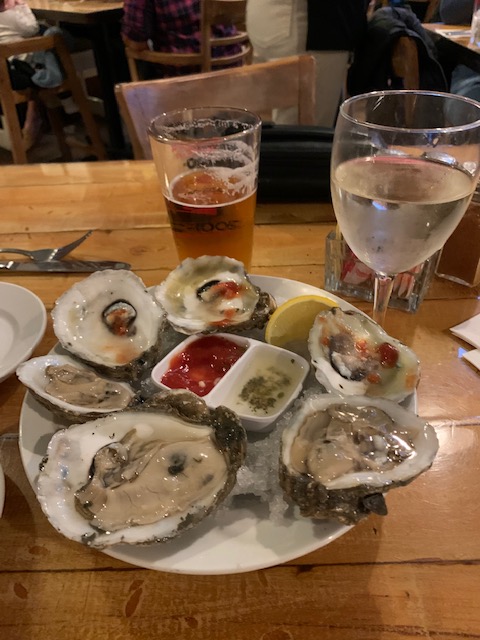
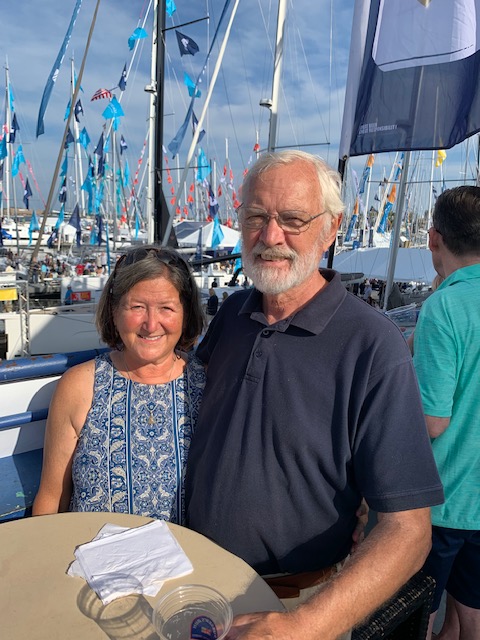
The Annapolis Boat Shows – Power and Sail – are annual fixtures and huge events, and we have been fortunate to attend several times over the years. This year was a bit different as we were missing the friends who have been with us in the past. We visited all the vendors on our list, and scored some good “boat show prices”.  For sailing offshore we needed a life raft and water maker – both big ticket items – and at the show we could compare all the options.  It was also an opportunity to meet several of our fellow Slocum owners. Emily and Lucas, on Alaya, live in Ann Arbor, and we had an enjoyable dinner where we introduced them to raw oysters! They visited Ritual the next day to make boat comparisons. We also had lunch with the owners of Serenata and True Love. Only 60 Slocums were built, and they are spread around the world, so it was special to meet in person with other owners and compare notes.

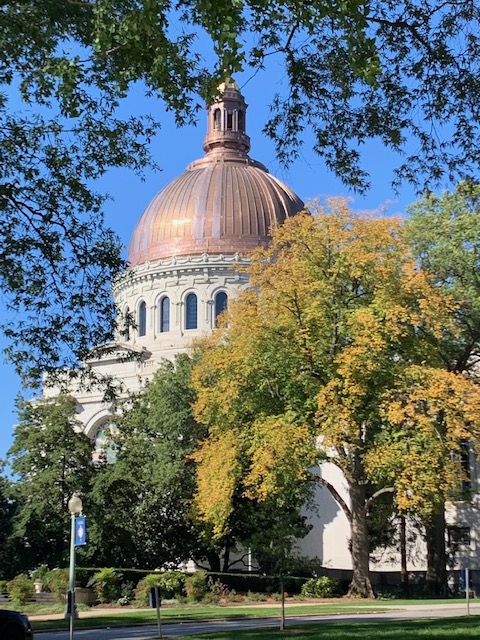
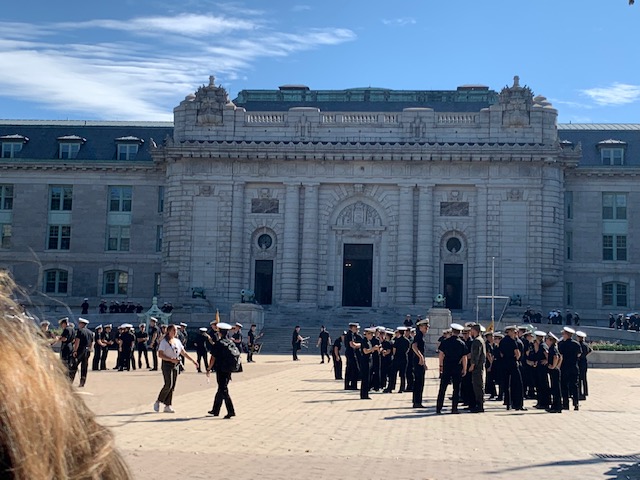
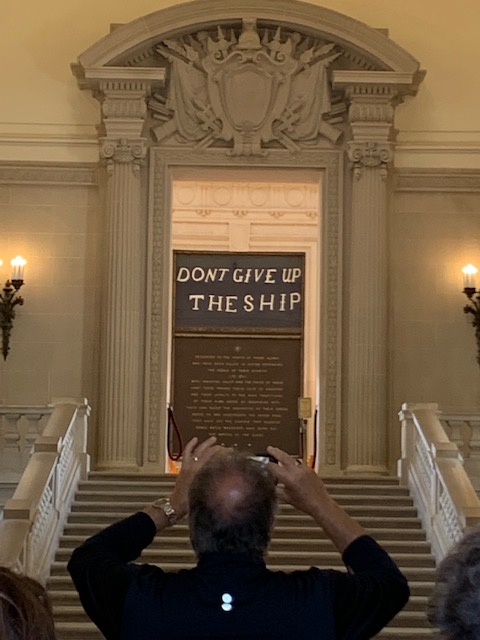
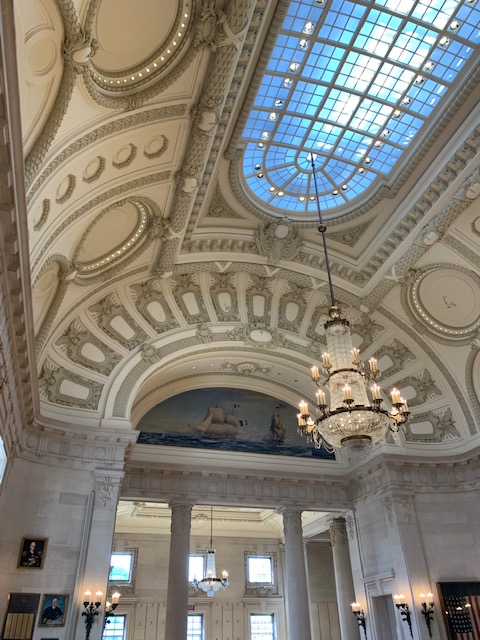
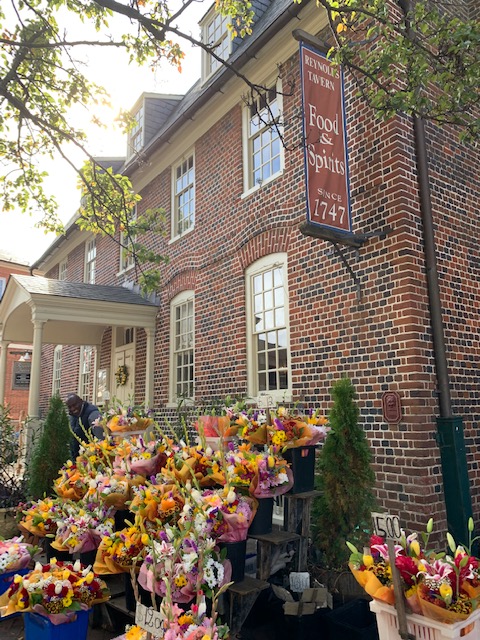
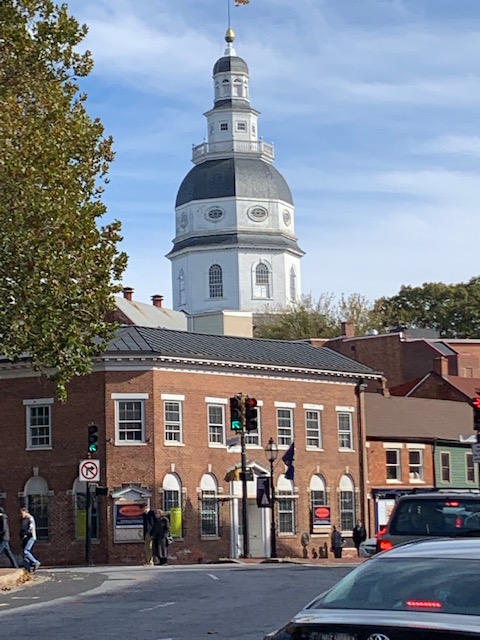
This is also the first time we have been able to see the city without the boat show hubbub. From our creek, we could dinghy to a street landing in Eastport and walk a few blocks to fun restaurants and the heart of historic Annapolis. We visited the State House – the oldest state capital in continuous use since 1783, and which also served as the nation’s capital. George Washington resigned his military commission here, and the Treaty of Paris was signed here, ending the Revolutionary War. We toured the beautiful Naval Academy (with a regimen we would not have survived, even as 18 year olds!). They display the original “Don’t Give Up the Ship” flag from the War of 1812, whose historic reminders we have encountered all along the way through the Detroit River, Lakes Erie and Ontario, and towns in Ohio, Pennsylvania, New York and Ontario. The Annapolis Yacht Club was a treat, since they had a fire and were closed when we were here two years ago. And the seafood goes without saying – oysters, mussels and crab – oh my!

Life in the boatyard takes on its own rhythm – not unlike life at home. Waiting for the engine guys, grocery shopping, ordering supplies, checking the weather, planning/fixing meals, laundry, boat cleaning, checking the weather, visiting with other boaters, researching the next several ports, getting the right part at the hardware or marine store, checking the weather, all make the days pass quickly.

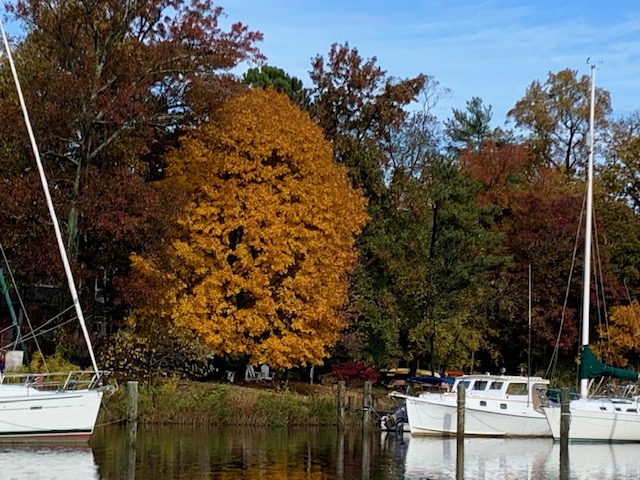
And finally, the engine is repaired (new raw water pump and alternator), the wind anemometer, radar and chartplotter are all hooked up and talking to each other, and we heard our first Single Side Band radio reception! We have watched the trees change color, and the nights are getting downright chilly. It’s time to head south!

Fair winds – Fred and Lisa

Buoyed with confidence!

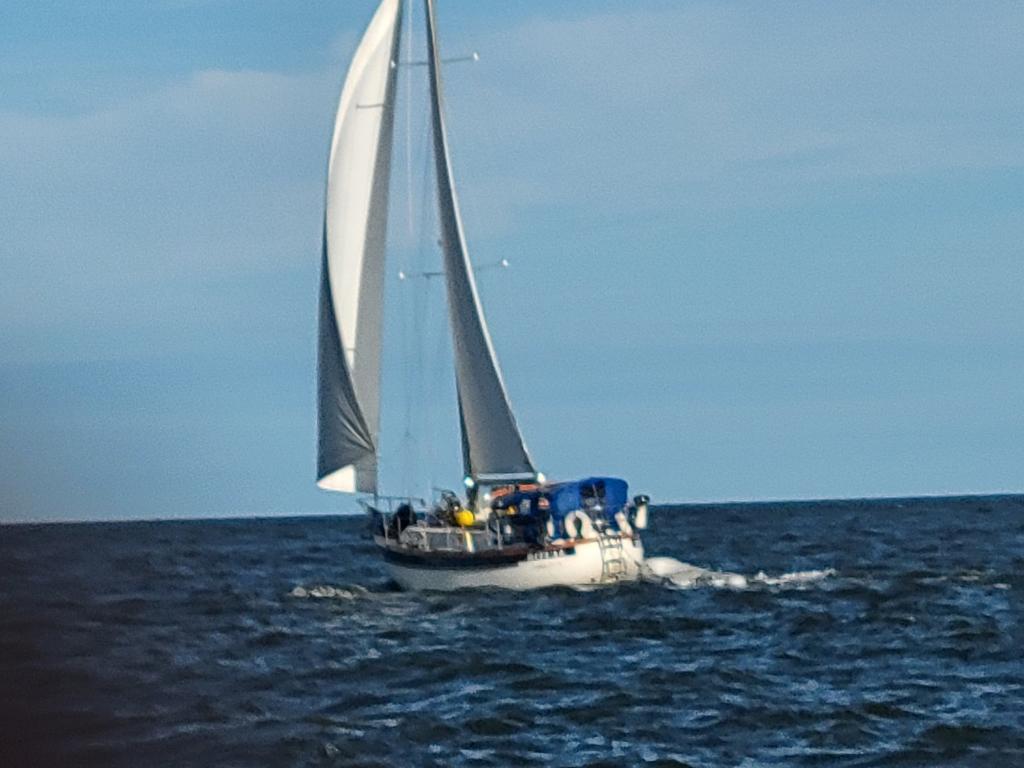
We had a beautiful two-day weather window for our planned overnight trip along the New Jersey shore to Cape May.  From here on out, we must consider tides and currents as well as wind direction and weather when we plan our routes.  All were in our favor and we enjoyed a great motor-sail around Sandy Hook and south along the Jersey shore. It was at dusk that Fred noticed our charging system gauge acting up.  He went below and found the wires to the alternator shorting out!  We shut things down while he went to work re-wiring, and when we powered up again things seemed right, and we were on our way.  Ten minutes later he went below to check things, and this time sparks were flying off the alternator!  We shut everything down once more, but now it was getting quite dark and we had no power – therefore no running lights.  The good news was that we were only three miles offshore from a large harbor where there would be help.  The bad news was that the harbor was Barnegat Bay, known for being shallow and having a tricky entry depending on the wind, tide and currents. Since we had planned to give this inlet a wide berth, we never looked at whatever amenities might be offered. We discussed the option of simply continuing to sail, but there were several fishing boats in the distance, and it seemed unwise to be out there with no lights and no radio.  Thank God for our cell phones – we could call for help and use the chart app on the phone to give our coordinates – as long as they stayed charged. For the first time in almost 30 years of sailing together, we called the Coast Guard.

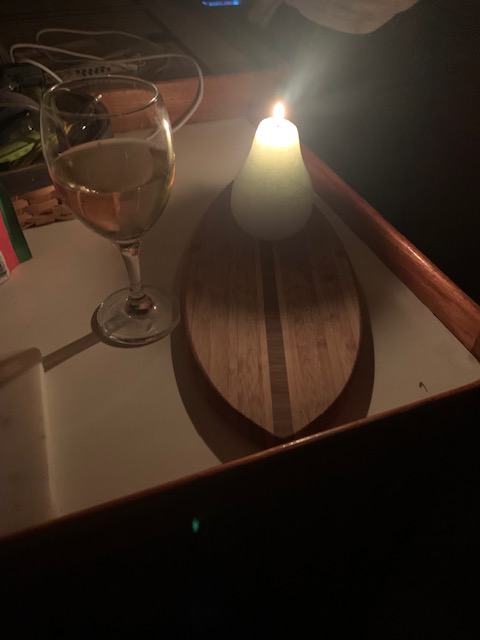
The Coasties were great – they contacted a tow boat for us, and then announced they were coming out to stand by since it might be 30 minutes or more before that boat would arrive. Randy, with TowBoat U.S., called about 20 minutes later to ask if we could see his lights (no….); or if we could see the lighthouse light (there were 200 different colored lights around the entry and we were three miles out, so no…); he finally shined a giant spotlight – bingo! Fred was shining a flashlight on our sails so he could see us, and he quickly threw us a bridle, with strict instructions to steer directly behind him as he brought us through the choppy inlet and into a small anchorage.  There was an empty mooring ball, but we had no boat hook with which to grab it (see the previous 79th St. Boat Basin saga…), so we dropped the anchor.  By now it was 10:30 pm, and the agreement was that he would return at 7 am to take us to a boat yard for service.  We lit some candles, had a BIG glass of wine and some snacks, and actually had a peaceful night.

Randy appeared at 7 am sharp, and Fred hand cranked our all-chain rode and 50 lb. anchor up (this exercise really makes one appreciate a windlass).  This time the towboat tied to our port side and we moved through the marked channel of Oyster Creek, hugging the green buoys to stay in enough water for our 6 ft draft.  We bumped bottom three times!  To be fair, Randy had wanted to begin at 6 am due to the tide, but Lisa argued for 7 so we would have some daylight.  An hour and a half (7.5 miles!) later, we were led up the Forked River and coasted into a slip at Tall Oaks, a marina that specialized in sailboats.  The locals pronounce this river as two syllables -fork / ed – but you can imagine the “forked” jokes that ensued.  We were pleased that an electrician was on the job by 1 pm, and after replacing a 200 watt burned out fuse, an insulator and some wires, and checking numerous other connections, everything seemed to be functioning as it should. 

We had a nice dinner down the street, and left early the next morning to get back to the ocean while there was enough water in that creek!  Although Randy had suggested we call him for an escort, the marina manager encouraged us to just go. “Stay in the middle of the channel and you will be fine”, he said, and buoyed with confidence (pun intended) we struck out on our own. The inner half of the bay is wide and 9 to 10 feet deep, and we made good time to Oyster Creek. These “creeks” are not of the Michigan variety, but simply dredged channels through the estuary, and it can be difficult to see the red and green markers. Following the chart, we entered the marked channel and stayed in the middle.  At the third set of buoys we bumped bottom, and got stuck. Try as we might, we could not get out of the mud. The big sport fishing boats flying past with their huge wakes only served to push us further towards the edge of the channel. A tow boat approached, but it was not Towboat U.S., with whom we have unlimited towing through our insurance. He grudgingly agreed to call Randy, who arrived within 15 minutes, giving us an eye roll. “WHY didn’t you call me this morning?” he quizzed, and “why didn’t you follow the green buoy side of the channel?” Ahh – pride goes before the fall.  He easily pulled us off the mud, and admonished us to stay on the green side. We thanked him and promised, and we were once more on our way. As we approached Myers Hole, where we had previously spent the night on anchor and knew the water was deeper, we relaxed a bit. The inlet was not too far, and soon we would be in the ocean again.  All of a sudden the boat lurched forward and really ground to a halt!  Lisa had taken her eyes off the chart, and had mistaken a miscellaneous can buoy for green. (In my defense, it had green tape all around the top). Fred is colorblind, so he was looking for pointy top markers (red nun buoys) or flat can markers (green cans).  Our position on the chart showed us clearly stuck on a marked shoal. When Randy answered his phone, he didn’t even say hello, just “You’re stuck again, aren’t you?”.  He came to our rescue once more, only this time it took quite a bit of effort with his huge twin engines to pull us off. Once freed, he insisted on leading us out the inlet, with strict instructions to continue north one mile, then east at least two miles, before we made the turn south, in order to miss the infamous rocks and shoals that lay on the south side of the inlet. Thus ended our adventure in Barnegat Bay (sounds like a sea chantey in the making!).

As we headed south towards Cape May, the winds unexpectedly switched and we found ourselves motoring into growing waves with the wind on our nose. We had hoped to run with MT Pockets, a boat we had met in the Forked River, which was also headed south, but there was no sign of them. Due to the building seas and uncomfortable ride, we decided to go into Atlantic City for the night. As we neared the inlet, we heard MT Pockets hailing the Coast Guard. They had gotten broadside to a big rolling wave in the entry, and temporarily lost propulsion. They were able to recover and enter the harbor, but our anxiety grew about what to expect in that inlet!  We stayed 2 miles offshore and entered the inlet with the rollers behind us, literally surfing into the harbor.  On either side of the jetties, huge curling waves were crashing onto shore. It looked like Hawaii Five-O, no kidding!  We were happy to drop the hook in quieter water in an anchorage just inside the harbor.

The morning brought calm winds, and we could not see any white water as we looked out the inlet. Over our coffee, we were trying to decide if we should stay or go, when MT Pockets called. They had left 2 hours earlier and found good conditions in the ocean. We were soon trailing them toward Cape May. It was a lovely day motor sailing, and we entered the inlet uneventfully and anchored near the Coast Guard station along with 10 other boats.

Cape May is a charming historical port and we were looking forward to spending a few days here. Settled by whalers and fishermen in colonial times, the entire town is on the National Register of Historic Places. We walked the streets lined with 19th century Victorian homes, and watched the large commercial fishing boats and whale watching excursion boats come and go from the harbor. We also listened to the new Coast Guard Cadets as they went through training. So much yelling – dawn to dusk. But it was fun to hear Reveille and evening Bugle Call. It reminded Lisa of summer camp, except for the yelling!

It was on our second morning here that we noticed the amp meter acting up and realized our charging system was still off kilter. We had to find a marina slip so we could plug the boat in and get our batteries charged again. We found ourselves three slips down from MT Pockets (Mike, Tiffany and dog Penny). Fred had several phone conversations with the electrician who had worked on the boat earlier in the week, as they tried to pin down the cause of our troubles, and Mike helped Fred go through some of our systems. They discovered that a starter battery post had melted off (can’t be good), and he let us use his account at West Marine to get a new battery (the last one in stock!). Again we find boaters to be a friendly and generous tribe.  

Figuring we could get two days of running with our batteries and solar panels, and then take a slip for charging things up, we left with MT Pockets at 7 am the next morning for the run up Delaware Bay to the C and D Canal, which would connect us to the Chesapeake Bay. This is a storied passage where tide, currents, wind and shipping lane traffic can make the 50-mile run unpleasant. We lucked out with calm seas which allowed us to shortcut the shoals around Cape May, and ride the flood tide up into the bay. We only passed 2 freighters, and had the tide against us for just a few hours later in the day. We entered the canal around 4 pm, and by 6 we were tied up to the west end wall at Schaefer’s Canal House and Docks.  As we secured Ritual to the dock posts, someone yelled from the balcony above, “Hey Traverse City!”. 

Fair winds, Fred and Lisa
Down the Hudson River to NYC

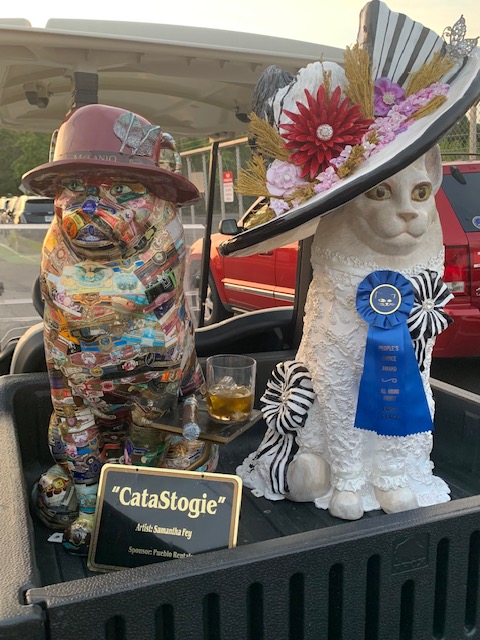
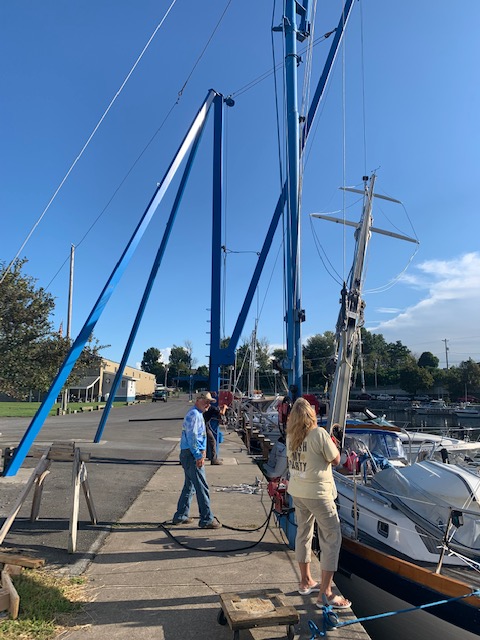
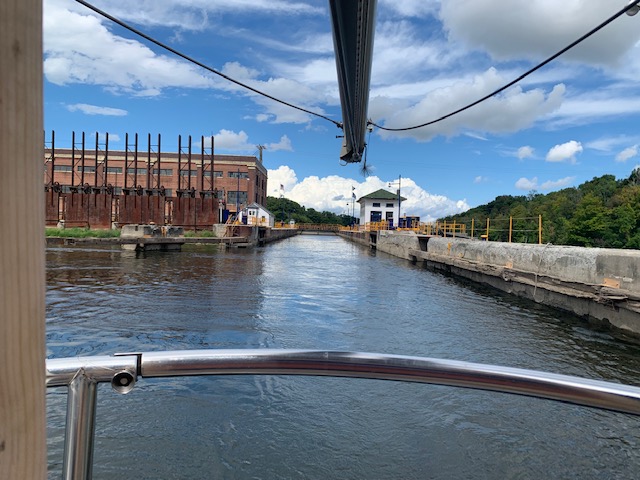
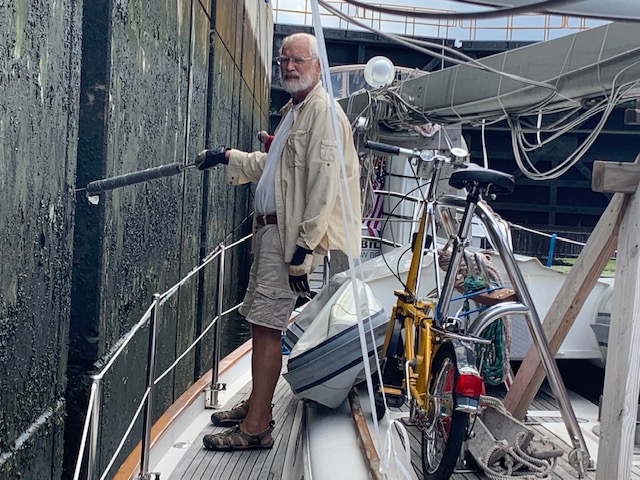
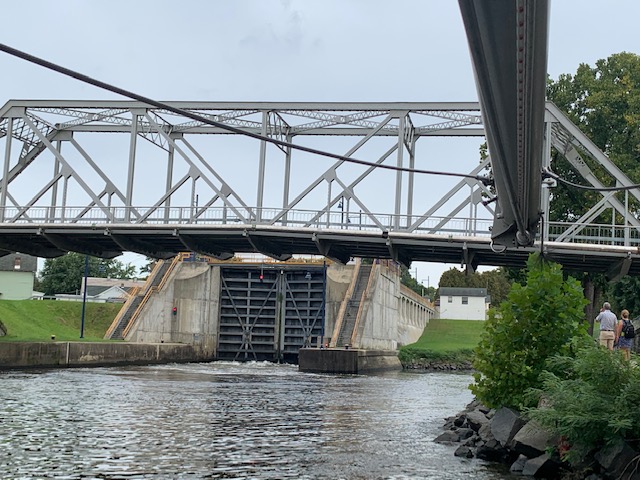
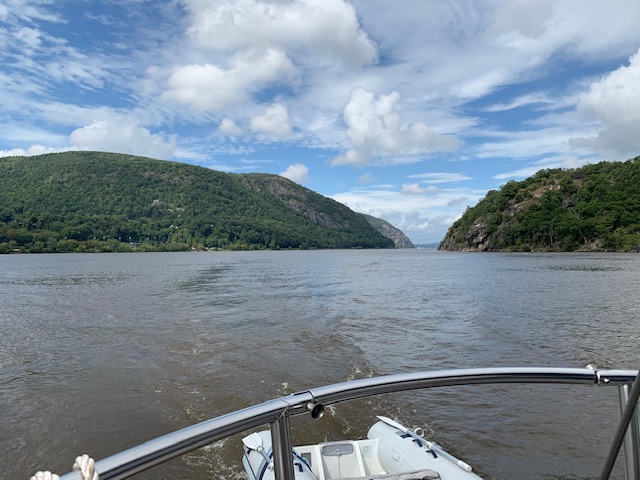
There was one more lock to contend with on the Hudson River.  The Federal Lock separates the upper Hudson estuary from the lower river and its tidal flows. It is a big lock, built for ships, and one must hook a line to a cable amidship and ride it down.  We locked through with 3 other boats, and were happy that the rumored strong current was not too bad. Our first stop would be in Catskill, to have our mast stepped and become a sailboat again. The folks at Riverview Marina were great, and our mast was up by 11 am the next morning. We took another day to make sure all the rigging was in order, which allowed for a dinghy ride up the creek to a shoreside restaurant, laundry, and seeing a bit of the quaint town. A fellow cruiser had told us about the artsy cat statues in town, but they were being auctioned off that evening as a fundraiser. We got to see a couple going to their new home, and now the artists have all winter to create new cats for next year.  We also noticed many town and waterway names ended with “kill”, and wondered if cats, fish and Indians were actually “offed” in these places! Then we learned that kill is a Dutch word for a creek, inlet or river – thank you early settlers of New Netherland and New Amsterdam.

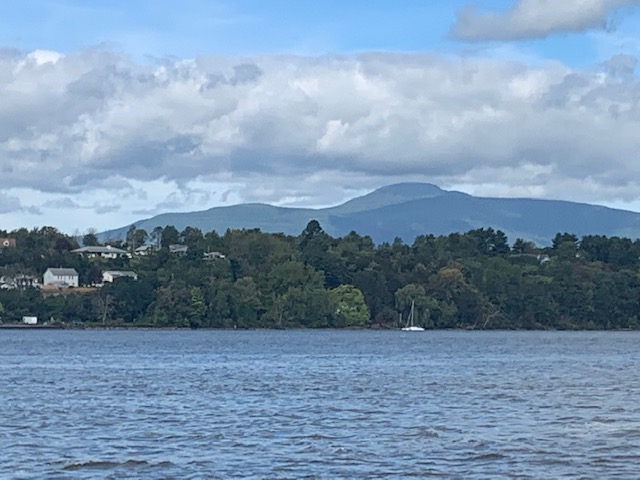
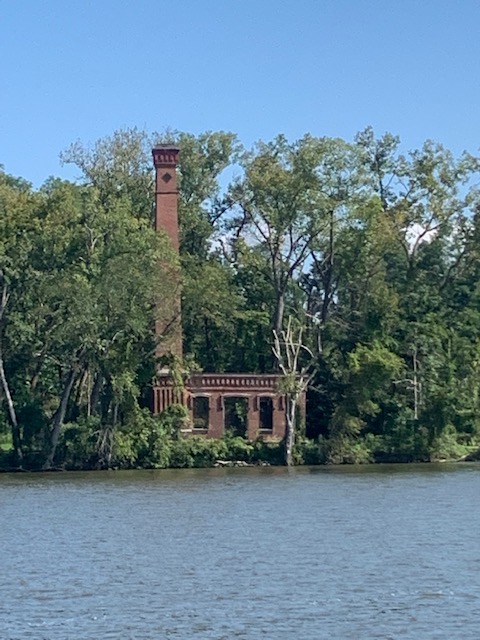
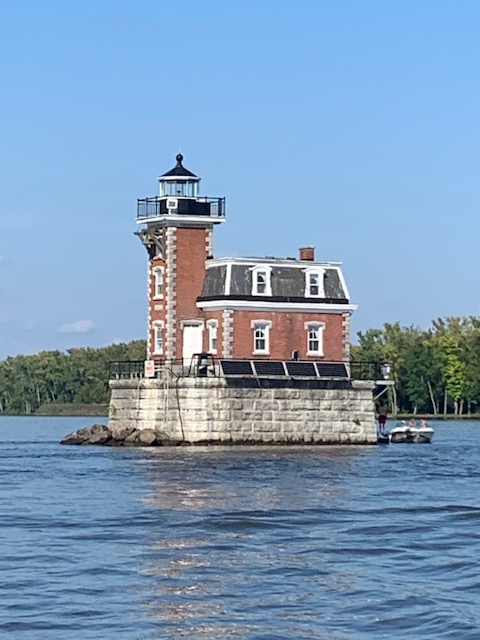
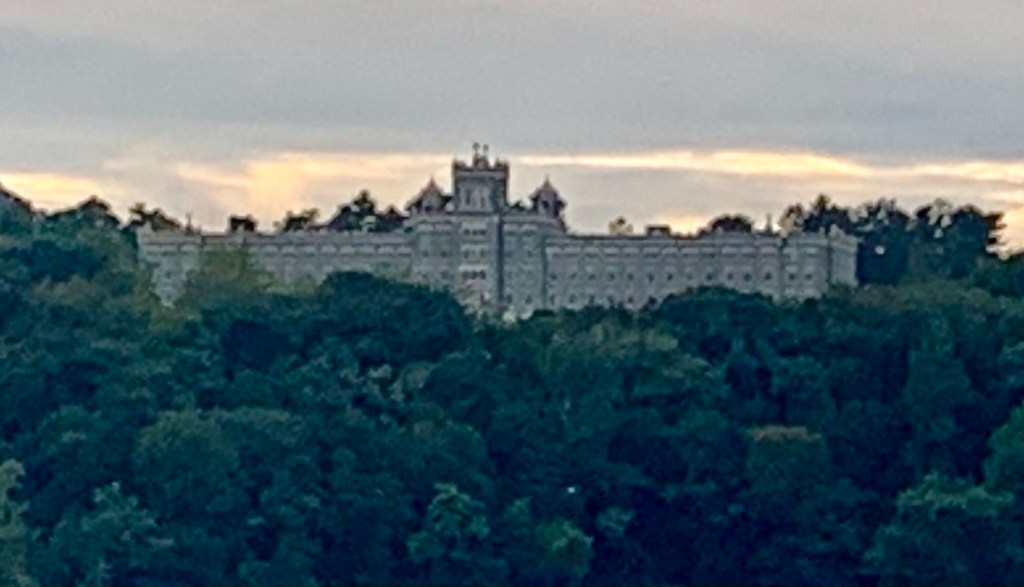
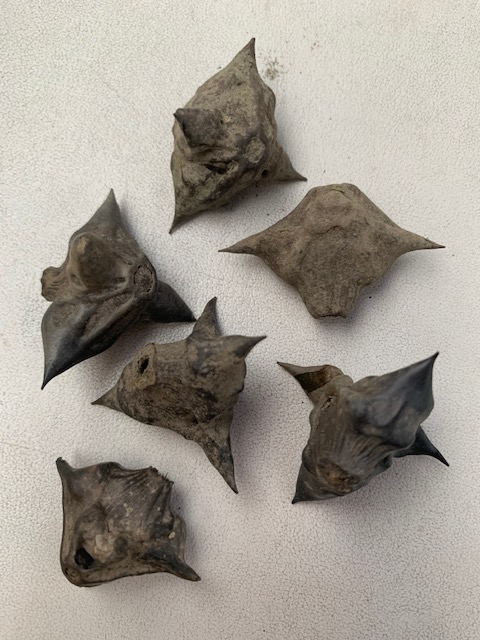
We found the Hudson more beautiful the further south we travelled.  We encountered several rowing crews racing near Albany, along with many fishermen, and the capital building looked quite historic contrasted with the newer architecture.  Near Catskill the misty mountains began appearing in the background.  There were many areas along the river set aside as state parkland or conservation areas. Our stop after Catskill was the Mills Norrie State Park Marina.  This park includes the gilded age Mills Mansion, one of many along this stretch of the river, including the Vanderbilt Mansion, the FDR Home and Library, and Eleanor Roosevelt’s home at Fall Kill. We looked across the river to an old monastery, now a private high school, and enjoyed hearing the carillon echo across the hills. Lisa found some interesting pods along the creek, the ranger explained they were water chestnuts. These plants have invaded the waterways and threaten to choke out everything else.  Park staff rake them up by the roots, and there were wheelbarrows full of them sitting at the edge of the marina.  Given the tide timetable we had to leave our dock early the next morning, and headed for Haverstraw Bay south of Peekskill. 

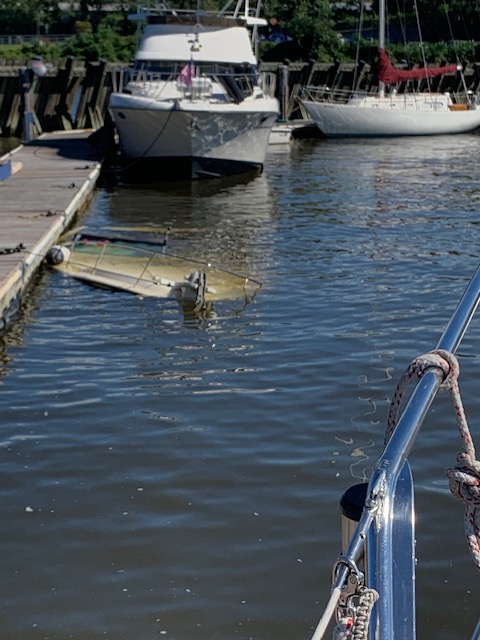
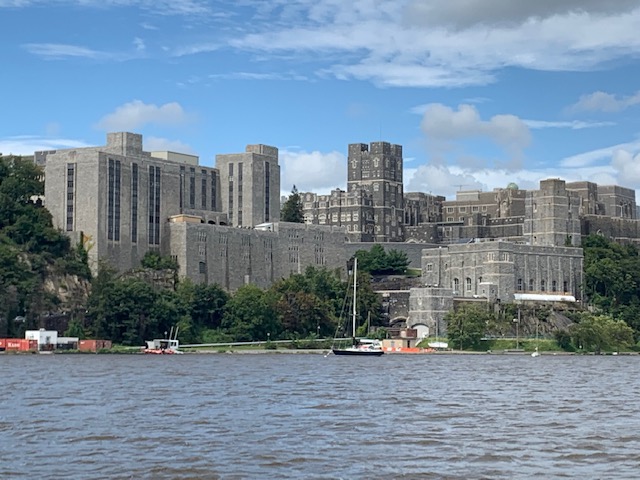
The Palisades Cliffs run from Bear Mountain (north of West Point) all the way to the George Washington Bridge in NYC.  The river bend near West Point is called World’s End – named by ship captains navigating through this narrow canyon of the Hudson Highlands. They give radio “securite” calls before they enter – good thing because we could not hear or see them until they were very close – and we had two large barges pass us in this stretch.  The river opens up in Haverstraw Bay, where we took a slip in Croton-on-Hudson to ride out the predicted thunderstorms before we headed for NYC.  We were happy to be tied up as the winds and rain rolled through, but shocked in the morning to see the boat in front us had sank!  We left before we found out the cause, trying to ride the ebbing tide and current to NYC, where we were meeting our daughter.

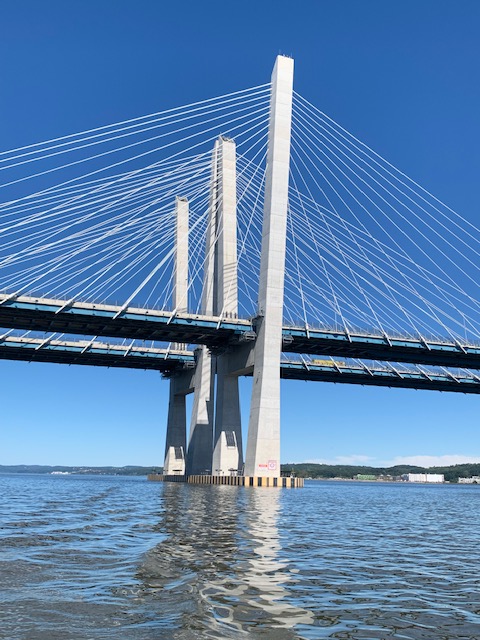
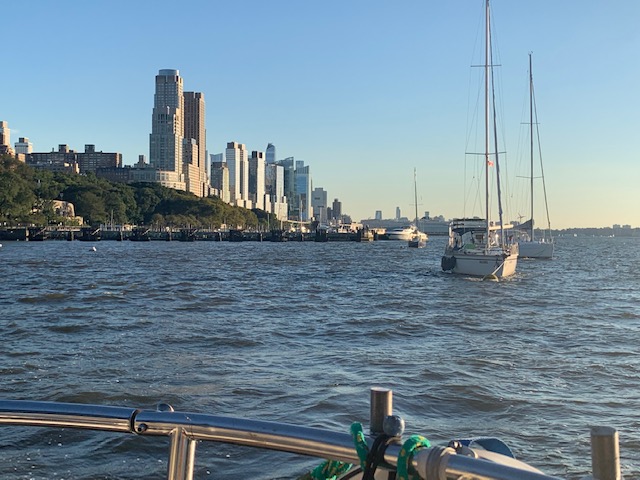
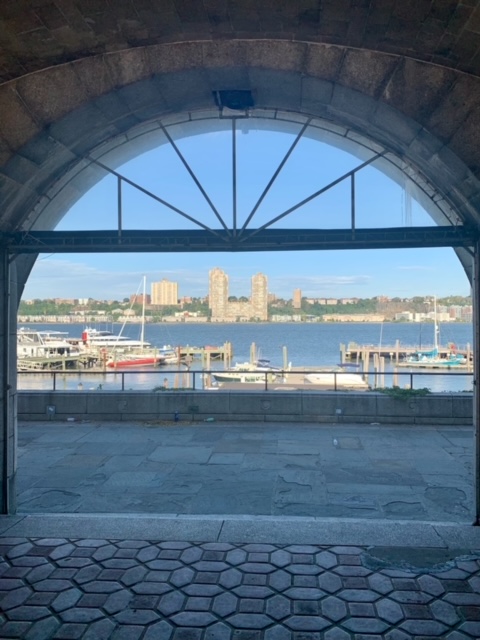
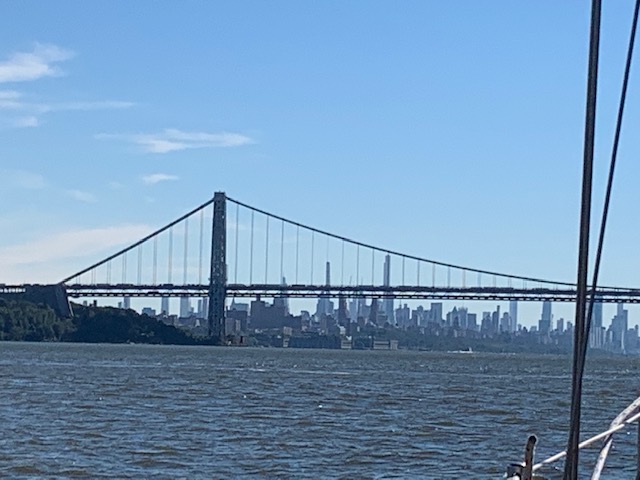
We passed under the Tappan Zee bridge and skyscrapers came within view.  Seemed like forever until we actually passed under the George Washington Bridge and neared the 79th Street Boat Basin on the Upper West Side.  This location is 3 blocks from Broadway and a subway station and 6 blocks from Central Park.  The plan was to grab a mooring ball here ($30 a night vs $140 for a slip) and spend several days with Lauren.  

What ensued was more like “Laurel and Hardy catch a mooring ball”.  We approached the ball against the 2.5 kt current, but the lines on the ball were wrapped tightly underneath the ball around the chain and we couldn’t get the boat hook on a line to pull it up. On the second pass, the boathook got entangled in the line, and the choice was for Fred to lose an arm or the hook (he still has his arm).  On the third pass we tried to grab the boathook with the fishing net but no luck, and it was last seen floating down the Hudson.  We decided that Lisa would get in the dinghy and grab the ball, then pull out a line and hand it to Fred, but she dropped the tow line before reaching the ball and was now also being carried downriver, despite rowing like the dickens (the motor was still riding on the stern rail of Ritual).  Round five – Lisa gets ahold of ball and line, Fred gets Ritual tied on, and we end up using our own bridle to actually attach to the mooring ball.  O…M…G.  In the morning we put the engine on the dinghy to go into the marina to pay and meet up with Lauren, but it wouldn’t start!  After several attempts, and while being rocked by ferry wakes, we gave up and took a slip. The docks at this basin are old and rickety (and slated to be completely reconstructed after this fall), and still rocked violently with the occasional big ferry wake, but at least we could come and go for a few days without worrying about getting to shore.

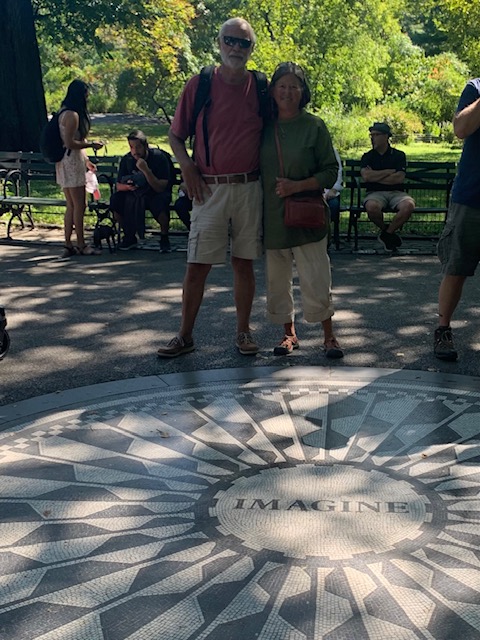
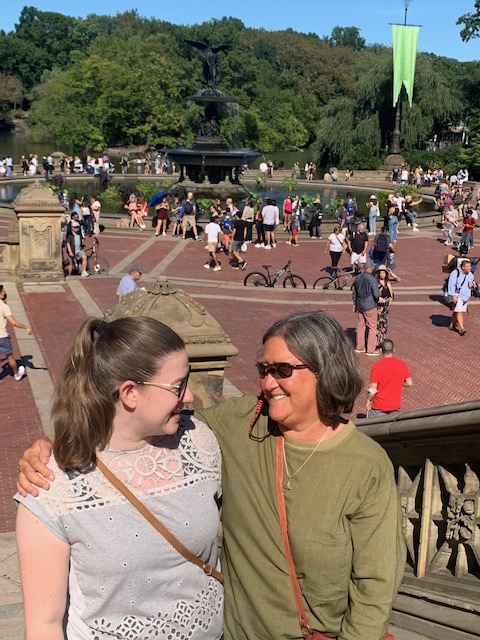
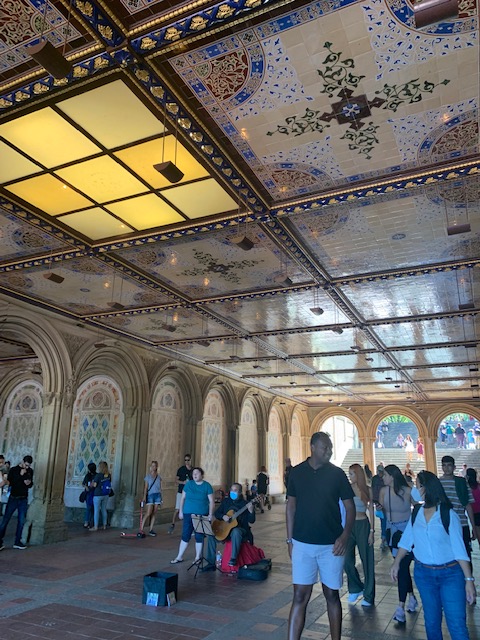
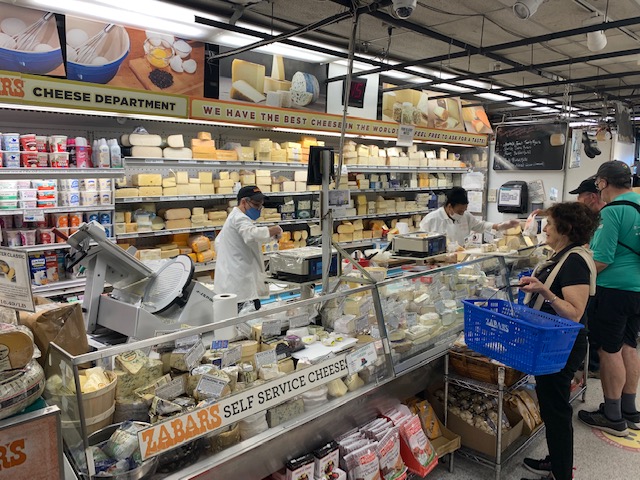
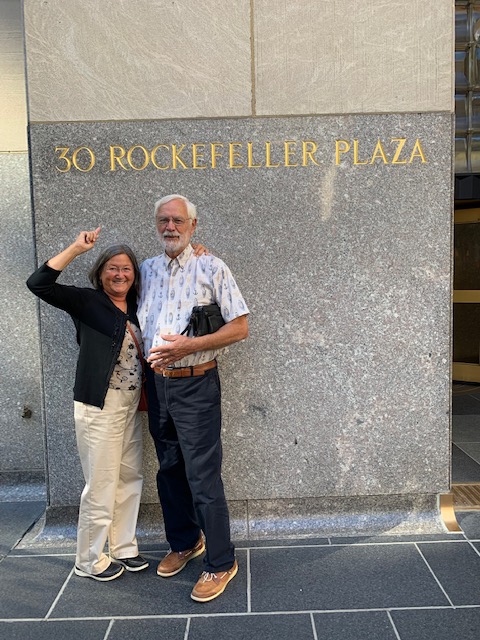
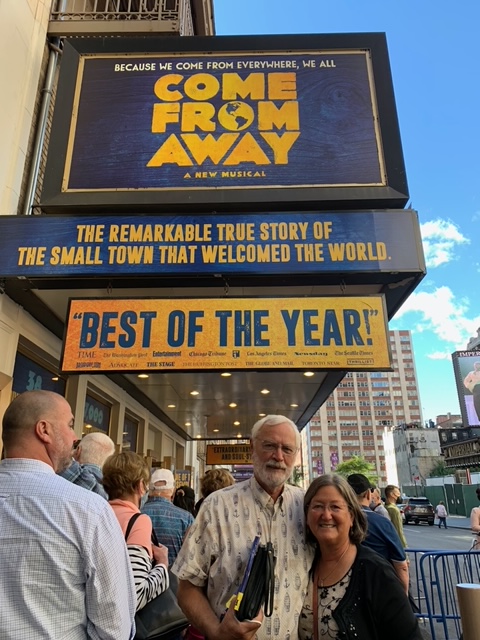
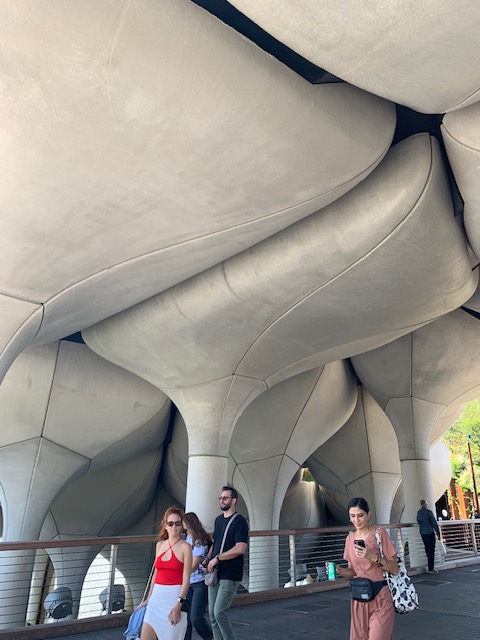
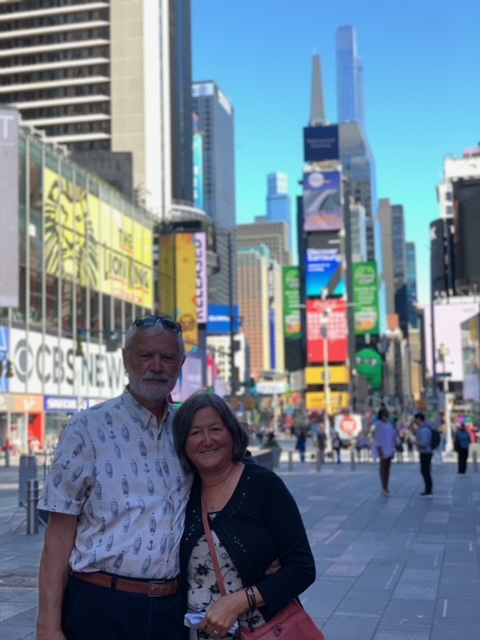
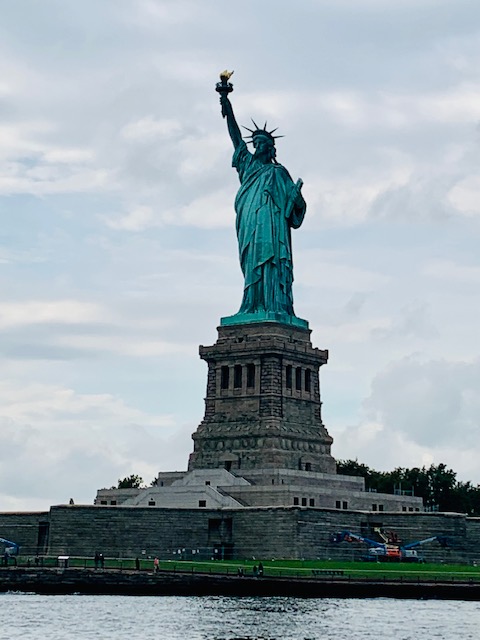
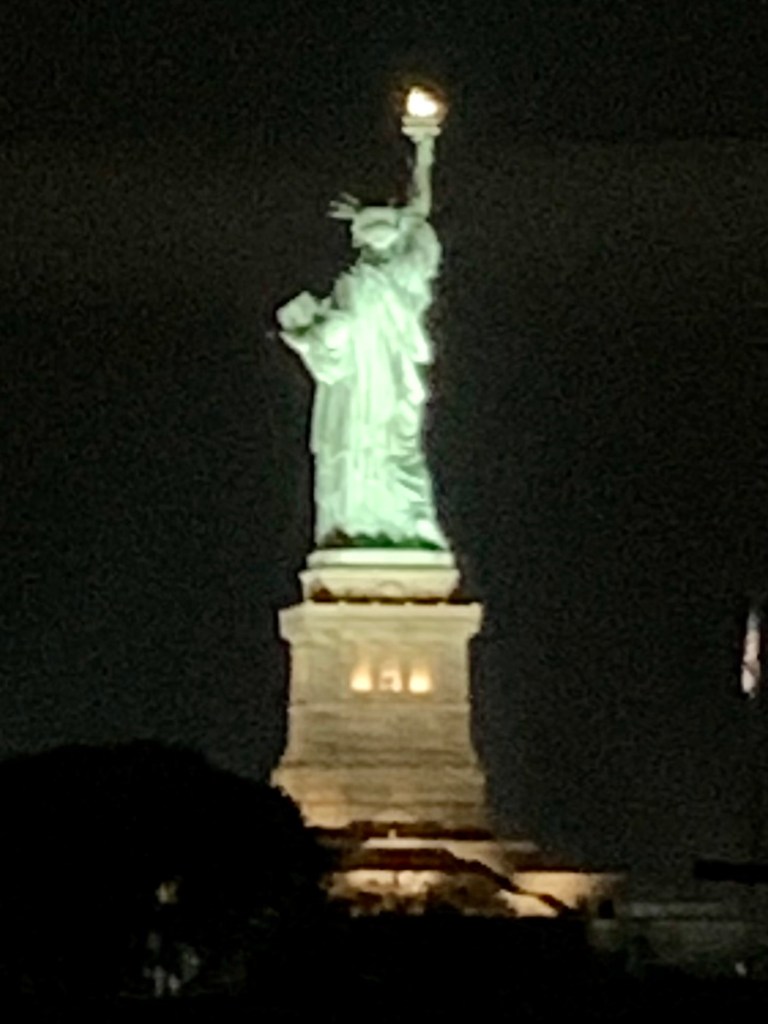
We had so much fun with Lauren – we walked through Central Park, ate some great meals, shopped at Zabar’s deli, walked Times Square and attended a show (Come From Away – excellent!).  We were on the waiting list for Late Night with Steven Colbert, but didn’t get in (bummer – his guest was Jon Stewart!), and had fun at the Chelsea Market and the new Little Island Park on the Hudson. It ended all too soon, and after we said goodbye on Tuesday we headed for the anchorage behind the Statue of Liberty.  What a cool spot when the lights came up on the city skyline, and the statue lit up.  It was great to enjoy a quiet night after all that rocking and rolling at the dock.  From here we headed south under the Verrazano-Narrows Bridge and across the Lower Bay to Atlantic Highlands, NJ to prep for our offshore leg around New Jersey.  Tucking behind the breakwall, we anchored here and visited the quaint little town and the Yacht Club. This area had been severely damaged from Hurricane Sandy, but seems to have rebounded, and the large marina was full.

Fair Winds, Fred and Lisa

Into the Ditch

We arrived at Oswego, NY a few days early so that we could sit out the forecasted thunderstorms.  Our first destination was the Oswego Yacht Club, which had welcomed fellow sailors from GTYC (Annie and Dietrich on Calliope) a few years ago. Unable to get any response on the phone, Lisa emailed the commodore, and we received a sad note back that the yacht club had been “removed” by the city through eminent domain!  The harbor was under complete reconstruction, and eventually will be home to the City’s port – Oswego Marina. The current Oswego Marina is across the river- it is small and old, and home to the sport fishing fleet. They did not have room for us until “mast down” day, and the alternative harbor was reported to be very shallow and very weedy, so we tied to the guest wall in the river, in front of the hotel.  The good news was that our new refrigerator compressor and evaporator had arrived. Monday’s priority was getting that puppy installed, which went quite smoothly. How exciting to actually make ice instead of procuring and hauling it. Big smiles!

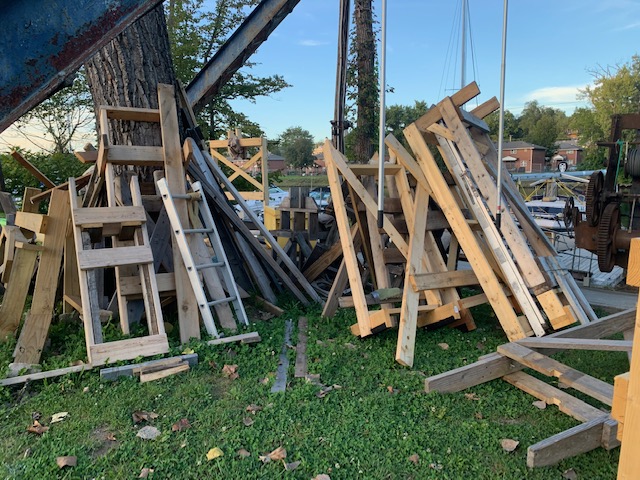
We thought our turn for servicing the mast would be Tuesday, but the marina had 2 sailboats in front of us with masts to be stepped (put UP).  They told us if we could get everything ready before 2 pm, we could still get ours down. The challenge was on!  We scoured the “bone pile” of discarded mast supports from other boats; measured stern, bow and mid-boat heights numerous times; and finally chose some supports that looked like they would work. By the time we got that completed, along with loosening the mast stays and clearing the decks, it was 2:30 pm. Too late for Tuesday, but we were promised that we could be second the next day.  Wednesday brought very dark skies and the rain began as the catamaran in front of us was getting his mast up.  Wanting to get ours done, but not really wanting to do it in a driving rain, we were quite relieved when the marina crew said “no way”!  Another day of waiting – what’s new?  We are resigned to learning to be more patient, since so many things are out of our control – the weather and marina schedules being two of those.

What does one do for fun in Oswego while learning patience?  We had a good Mexican lunch; paid 5 bucks to use the hotel pool, rec room and showers; had a bad lunch at the Press Box bar and grill (but the patio was nice); walked along the rail trail to the grocery and liquor stores (no wine in NY grocery stores) and auto parts store (hydraulic fluid); and walked to a neighborhood Irish bar because the Yelp review said they had the best corned beef – only to find there was no food at all, not even chips, except on St. Patrick’s Day!  And finally, walked across the Fort Ontario grounds (War of 1812 again) to a biker bar rumored to have good food. Score at the Woodchuck Saloon– excellent food, and the “bikers” looked mostly like us!  There are nicer establishments and more expensive venues on the west side of the river; the east side of Oswego is “working class” but walkable.

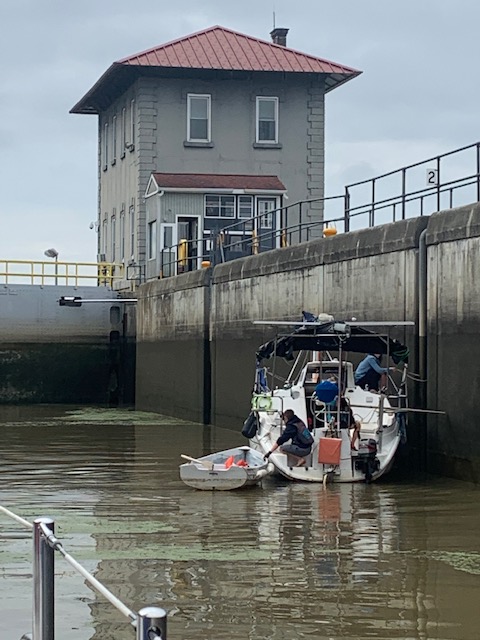
Thursday morning we pulled to the dock under the gin pole and within 2 hours the mast was down and securely fastened to the supports.  We got a pump out, topped off fuel, and entered our first Oswego Canal lock! The first few locks were as expected, but we were soon motoring along the Oswego River.  Most of us, when we hear the term canal, think of a concrete waterway, but those old waterways were mostly abandoned, and now the trip is mainly in riverways, with locks interspersed to deal with the elevation changes.  It really felt more like “The African Queen” than expected. Some parts of the river were wild and remote with thick overgrowth, while others had many cottages/homes, docks and boats.  We completed the 7 Oswego locks and 22 miles by 5 pm, and tied to the wall in Phoenix, a little town near the junction of the Oswego and Erie Canals. In the summer there is a crew of kids here that will run errands for boaters, but now that school had begun, all was quiet, and though there were several boats tied up here, most were locals.

Friday we motored to the canal junction with the Erie, and on to Brewerton, a small town at the entrance to Lake Oneida.  The lake is shallow, 20 miles long and 3 miles wide, and the strong northwest winds promised a choppy ride, so we pulled into the EssKay Marina for the evening.  GTYC friends Pete and Sue on Salsa had left a promising note on this marina, and we found it to be a great stop. Family run by several sisters (awesome and unusual!), small and quaint – it had the best stocked marine supply we have encountered so far. We had a long list – water line, pipe connectors, brass fittings, electrical wire – and Fred got everything but one item checked off. When he mentioned that she didn’t have one of the pipe connectors, she reached under the counter, rummaged around, and pulled it out!  They also had a courtesy car – Fred wrote our name and phone number in the book and was handed keys – amazing!  We used the car for a grocery run and to cross the river to see Traveler – a Juneau 50 carrying Daisy, Mike, their 2 kids and dog.  They had their mast dropped after us, and had passed us at the dock.  We decided to cross the lake together the next morning when the winds were forecasted to be light.

At 8 am we began the trek across the lake – a little concerned that any rolling from passing motor boat wakes could result in our mast rolling right over the side! While we did have a few wakes, the boat maintained her rig (which was tied down really well), and it was an uneventful crossing.  The summer town of Sylvan Beach lies at the east end of the lake. It has a nice beach and even an old-time amusement park, and of course Lisa wanted to stop here and tie on the wall. However, the park had just closed for the season, and it was not even noon, so we continued on.  Here the river became very shallow – 7 feet in places, and we watched the red and green channel buoys carefully. The river water is the color of Lisa’s morning coffee and you cannot see anything beneath the surface. There is also a lot of debris floating by – mostly branches and small logs that have been dislodged by heavy rainfall, and the occasional “clunk” as the boat hull meets one is a bit jarring. Since we were only moving at 6 knots, we managed to see and miss most of them.

It was 15 miles to Rome, NY, the end of the “middle section” of the Erie. Locks 22 and 21 would be the last locks where we would be raising up in elevation, 25 feet each. We passed beneath the bridge and headed for the newer docks to spend the night.  It had been reported as shallow but at least deep enough for us.  Next thing we knew, we were bottomed out!  After a few tries, we managed to back off and get back in the channel – whew!  We tied up to the old timber wall instead.  It was in bad shape, but we found a spot where we could jam in the big fenders and get off the boat. We thought no one else would join us here, although by late afternoon there were 3 more boats behind us.

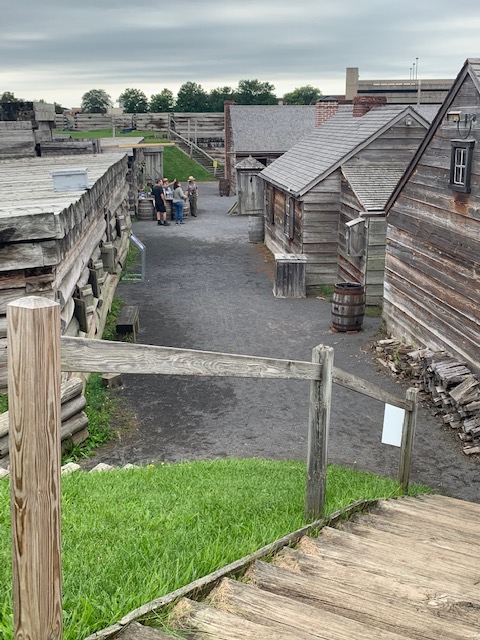
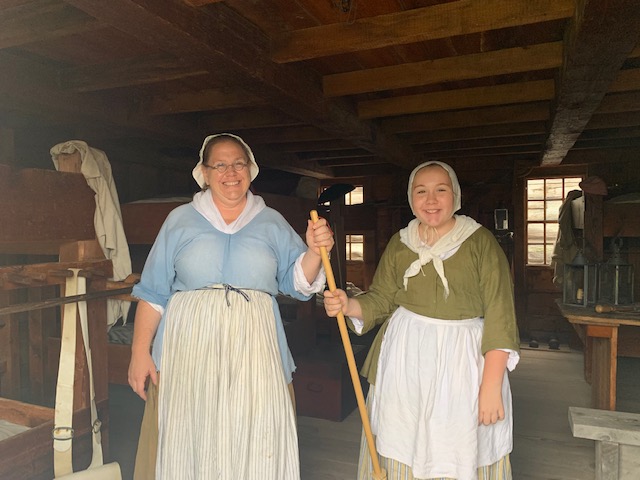
The town is small but has all the necessities, and the area we walked to was called Little Italy.  We had been noticing a lot of Italian names in the area and we took a chance on the Savoy Restaurant, one of the oldest in town. Wow – a superb meal, and a live piano player to boot!  The next morning we cycled in the drizzle to Fort Stanwix, a reconstructed Revolutionary War fort run by the National Park Service. Unfortunately, as we plopped the bicycles from the boat to the timber wall, we stirred up some little bees and both got stung, twice! The fort, rebuilt on its’ original foundations, was a wilderness fort at an important junction of waterways. The staff was wonderful and really brought the fort to life – a living situation which was difficult at best, and made a bee sting seem insignificant.

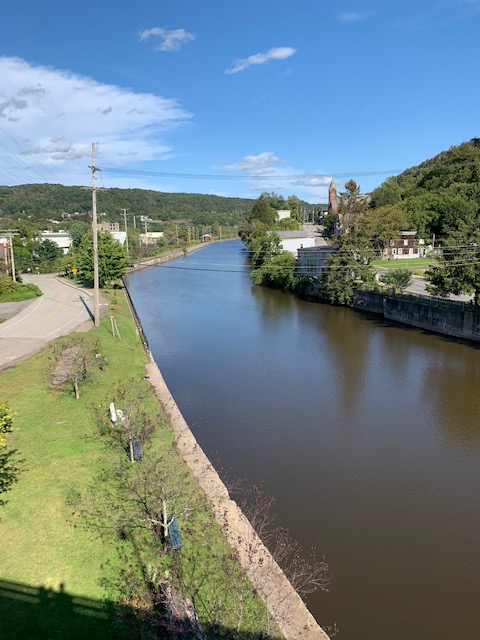
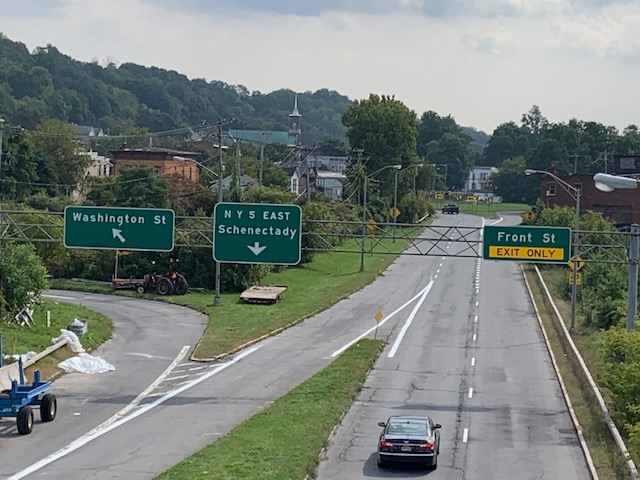
As we continued east on the canal, the rest of the locks all dropped in elevation, and became more frequent. Most days we motored 25 to 30 miles and transited 2 to 4 locks, also passing under numerous bridges. The mast was down due to the average bridge height of 23 feet.  Along the way many towns had either a small marina or a wall to tie to.  This part of the canal is actually the Mohawk River, and the shores were busy with trains and highways, so evening stops were pretty noisy, especially the train whistles!  However, the Mohawk valley was gorgeous, with vistas of high rolling hills and steep rock. Near Schenectady, we finally got away from I-90 and the trains, and had a quiet stay at the Yacht Club on the river. The last part of the river had large conservation areas, and the herons, egrets, and other birds were numerous.  The last 5 locks were set up as a “flight”, one into the next, with it’s terminus at Waterford, NY. As we exited the last lock, we snapped up one of the few remaining spaces on the long town dock to rest and celebrate completing the canal. It was September 17, about 4 weeks later than we had originally planned, but we were glad for the delays – we got to enjoy Canada and the Thousand Island area, and missed all the heavy rains from Hurricanes Henri and Ida, which had inundated New York City and Albany, causing the canal shutdowns.  On we go!

Fair Winds, Lisa and Fred

Back in the U.S.

(Note:  Trying to get caught up in real time!  We are currently in the Hudson River, planning on arriving in Manhattan, NYC this afternoon, 9/25)

It was a just a couple hours run from Brakey Bay, CA to the US side of the St. Lawrence, and we entered at Clayton, NY.  Even though we had reported back into the country by phone app (CBP Roam – pretty cool) and had a clearance number, boats must declare a port of entry in case Customs decides they want a look at you.  We never saw them – we have a long history of coming/going to Canada which is all in their database and probably helps (once they even asked where the dog was! He had passed on, we asked them to remove him from their notes.) Clayton’s marina didn’t answer and the municipal dock was full, so we anchored in the bay and took the dinghy to the dock for ice.  Even though the open hours were posted, no one was there.  We have noticed a definite lack of employees everywhere, and many things are closed on Mondays and Tuesdays as well. As we stood pondering lugging ice from the grocery store more than a half mile away, a couple walked up and offered to drive us to the store! People’s generosity is always such a pleasant surprise in the face of all the bad news we tend to hear about the world.

After we swamped out the fridge (REALLY looking forward to installing that new unit once we get to Oswego) we returned to shore for a walk around. The main street runs along the waterfront and has several restaurants and bars, shops and a great hardware store. There are lots of smaller motor boats that run across the river to the homes on the islands. Clayton is also the home of the largest Antique Boat Museum in the states.

We spent the night on the hook, grateful that we weren’t banging on the municipal dock in the chop from the NE winds. A couple in a small boat came by and told us we could take the empty mooring ball in the south part of the bay, but we were hooked well and not uncomfortable so we stayed put.  As they motored away, the woman hollered, “We love Traverse City!” (our hailing port is on the boat below our boat name).

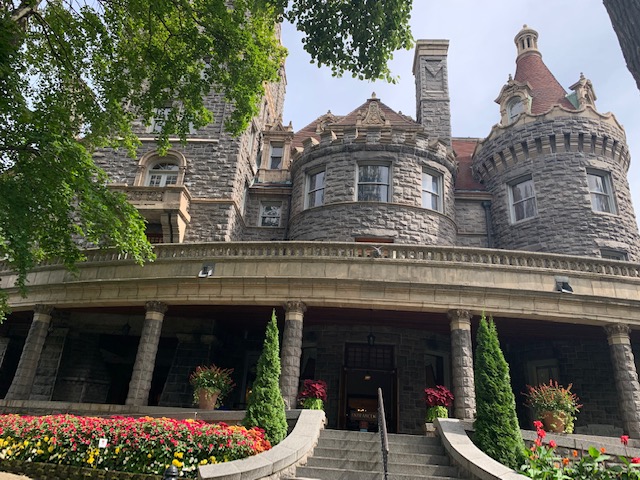
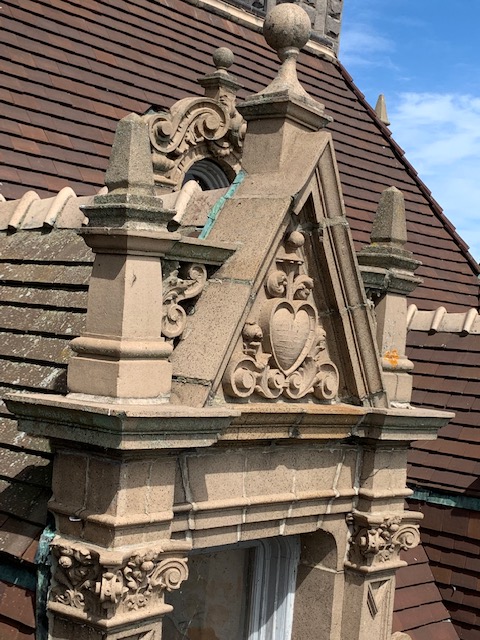
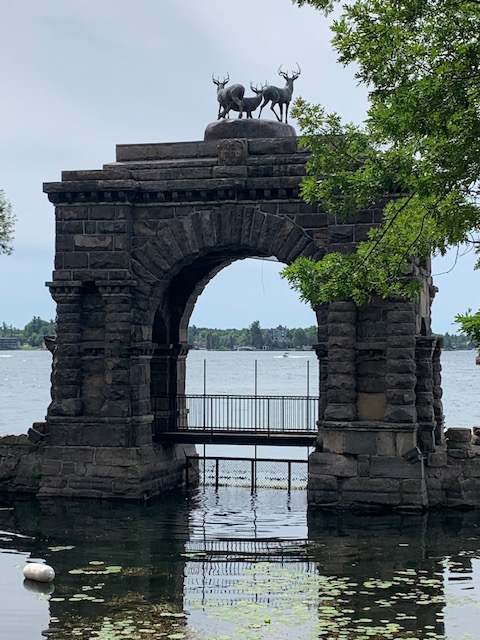
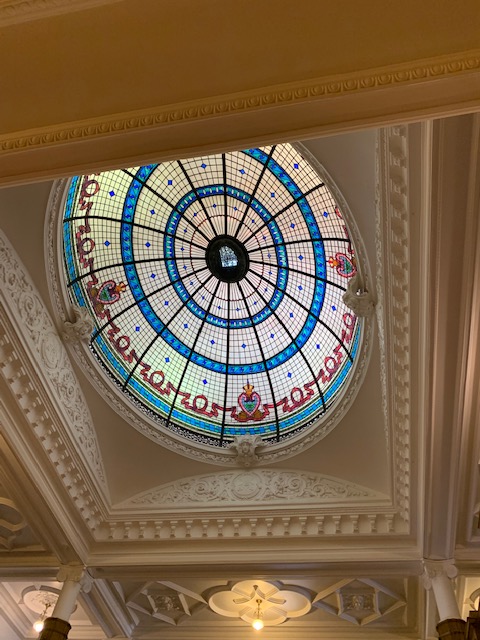
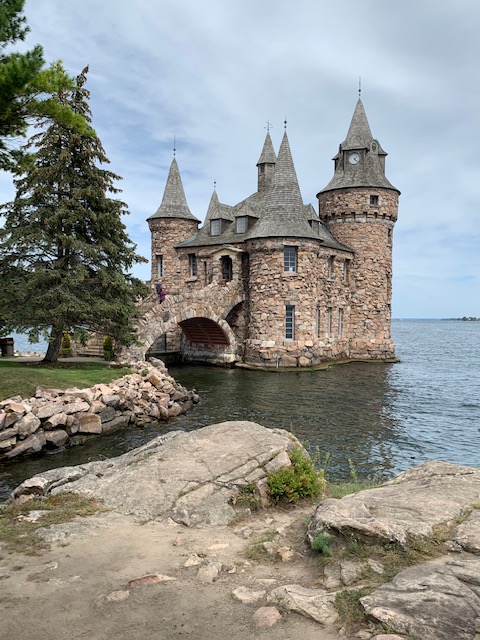
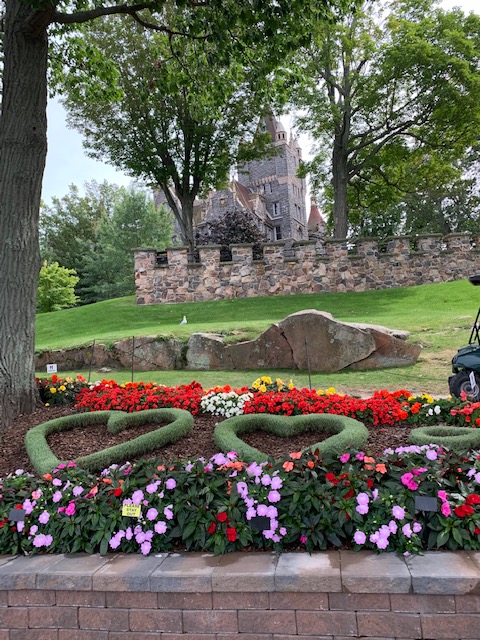
Our destination the next day was 10 miles north on the St. Lawrence to Heart Island, home of Boldt Castle. We anchored in a little spot near the Thousand Islands Yacht Club, and dinghied over. This mansion was partially constructed at the turn of the century by the manager of the Waldorff Astoria hotel in NYC for his wife. Sadly, she died before it was finished, and he called off all workers and walked away.  It sat abandoned until the St. Lawrence Seaway Commission took it on in the 70’s. They have been working on the restoration ever since.  Although the family never lived in the mansion, the complete plans and many details were available, and it is amazing. The family crest has a stag and heart, and those are reflected often in the architecture.  Even the boathouse is magnificent.

Travelling against the 2 knot current for our return trip gave us time to ogle the pretty vintage cottages and homes along the seaway, and to try to imagine the charmed life of spending summers in these islands. Across the river from Clayton we found a quiet wooded bay on Picton Island and anchored. It was very reminiscent of the North Channel with the forest and rock ledges. There was one cottage on the point, and as Lisa rowed around the bay, the owner came out to chat. Her family has had this property for 85 years, and now most of it is in a conservancy.  She grew up here in the summers, and lamented that on the weekends, the bay had become “party central” with rafts of boats, loud music, drunks, etc. The land is posted as No Trespassing, but she has no jurisdiction over the water.  On the one hand, we were glad because it was a lovely spot in which to stay, but we could certainly empathize with the disruption of the quiet beauty. 

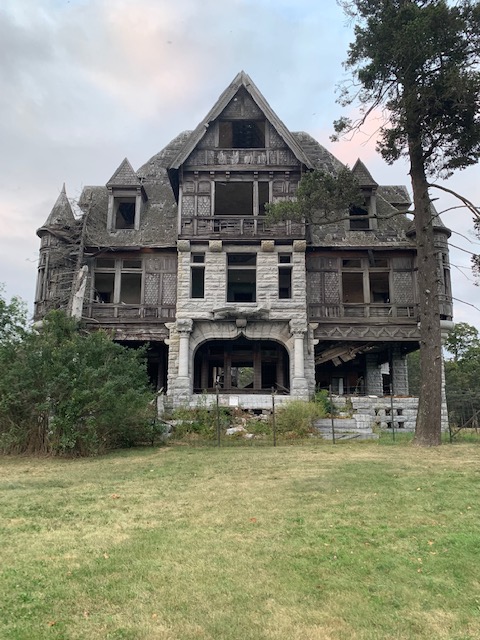
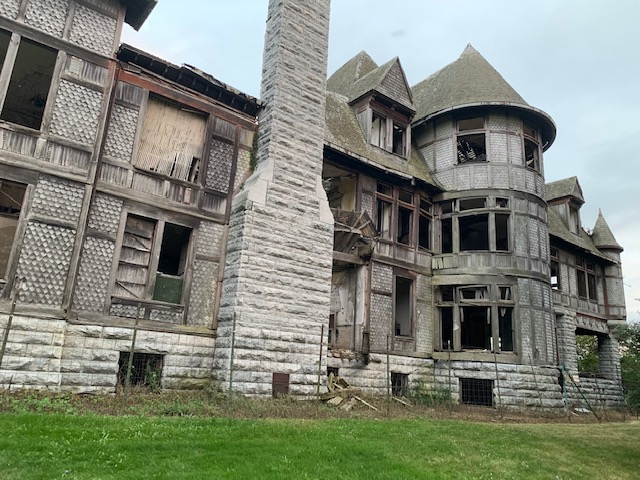
We continued south towards Oswego to another tiny anchorage on Carleton Island.  As we rounded the southwest tip we were shocked to see another mansion – this one a complete wreck sitting among other, more modern cottages.  After we anchored, a guy motored out to fish and welcomed us to the bay.  We asked if it would be okay to walk up to the ruins. He said yes, since no one was around, but do it that evening since the next day cottage owners would be coming out for the Labor Day weekend. This was the Wyckoff Mansion – abandoned during the depression, and left to slowly rot away.  It is for sale – $499,000, with a restoration estimate of 2 mil. No takers so far.  If you Google it, you can see some pictures of its former glory. 

To break up the 40 mile trek to Oswego our next destination was Sackett’s Harbor, NY, an historic summer town in this area.  We anchored at the mouth of the little harbor, and dinghied in for – what else – ice. And of course – no blocks. We were uncomfortable about the setting and unsure of the anchor holding, and decided to move to White’s Bay where we could get out of the building west winds.  Great call!  Fred grilled steak for dinner and we slept soundly, and set off for Oswego the next day.  The Oswego Canal had opened up on September 3rd, and we were in line to have our mast taken down on Tuesday, the 7th. We could finally enter the canal system!!

Fair winds, Fred and Lisa
Ontario – Ice Quest

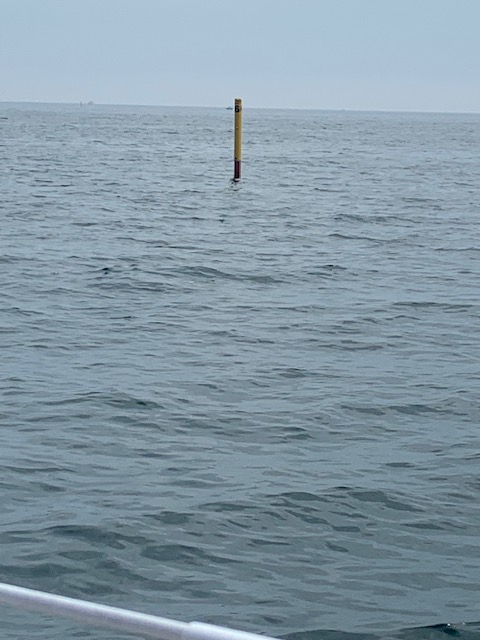
It was a warm and hazy day and it seemed that half of Toronto was out sailing as we left the quay and headed around the outside of Centre Island.  We motor-sailed in light winds, steering NE to Port Whitby, about 30 miles.  We had stocked up on ice (the marina only had crushed) and were hoping to score some blocks in Whitby.  We had also received news that the Oswego Canal had been indefinitely shut down due to high water from Hurricane Henri, along with several of the far eastern locks on the Erie Canal, so we were happy to be heading toward the Thousand Islands.  The trip was uneventful, with the exception of some weird “pipes” which we happened across all along the coast.  They only showed on the chart if we were zoomed way in, so the first one was a bit of a surprise!  They appear to mark pipelines and water intakes.  The coastline was reminiscent of Lake Michigan, with high sandy bluffs.

Whitby Harbour is well protected, but very shallow with no place to anchor out, so we took a slip.  The channel was only 8 ft. deep so we ventured in slowly and they placed us at the first dock. The marina was very nice with newer bathrooms/showers/laundry, but only had crushed ice!  We swamped out the fridge and added some more bags.  We have been really surprised by the lack of block ice, from PA to CA. Our old boat had an icebox that would hold for days with block ice, and since there seems to be a proliferation of sailboats old and new everywhere we go, it just seems odd that we can’t find any. 

The main part of town was not close, so we ventured by bike to the nearest small shopping center that had all the essentials – ATM (Canadian cash), LCBO, grocery store, pharmacy – all set! Our dock neighbors had just returned that day from a month in the Thousand Islands, and were happy to share some of their favorite spots with us, so we were ready to get going next morning. Their brand new Bavaria 42 – Esmeralda, was gorgeous and made Ritual look even more like a “working boat”!

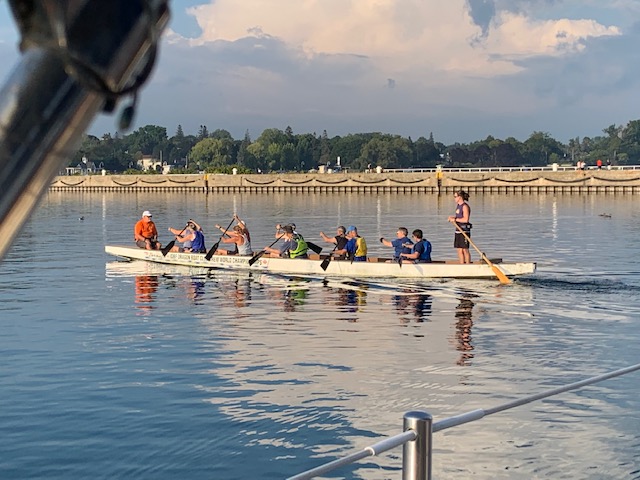
Our next stop would be Cobourg, another 30 miles along the coast.  This harbour is larger and deeper that Whitby, and we were happy to join several others anchored inside the breakwalls.  The marina sits one block from the charming main street, so walking was fun.  Cobourg is an old town, with many historical sites and old cobblestone buildings. It also has a tiny, but first-rate marine supply store. Or dingy gas tank/supply line had not been working well, even though Fred had taken it all apart, blew out the line (yes, he did, and yes, he did!), and tinkered with the connections.  Although Dean was extremely helpful, the parts he had would not fit. We did score some new line for the outboard motor hoist so we could run a double block, which makes it much easier to lift.  And, a minor miracle – block ice at the marina! We enjoyed watching the activity in the harbour – kids sailing, folks kayaking, dragon boats practicing, and people fishing and walking the breakwall. 

We sat out thunderstorms the next day, in anticipation of having better weather for the leg to come – a long 9-10 hour journey east around Prince Edward County and up into Prince Edward Bay.  Even though there is an abundance of shoreline, including Sandbanks Provincial Park, the two protected harbours we passed are shallow with entry channels at only 4-5 feet deep (we draw 6).  The alternative route through the Murray Canal and Bay of Quinte is also known for shallows and weeds and narrow, buoyed channels. So we opted for the outside, and rode lumpy following seas all the way. West winds prevail in this area, and with a fetch reaching all the way from Hamilton, the water can really pile up this far east.  One of the things we love about Ritual is her “canoe” stern, meaning her back end is rounded to a point, so the ride is a bit smoother since the waves tend to part as they hit us, rather than smacking against a flat stern.  It was still a relief to finally turn back west around Long Point and drop the hook in calm waters off the Little Bluff Conservation area.

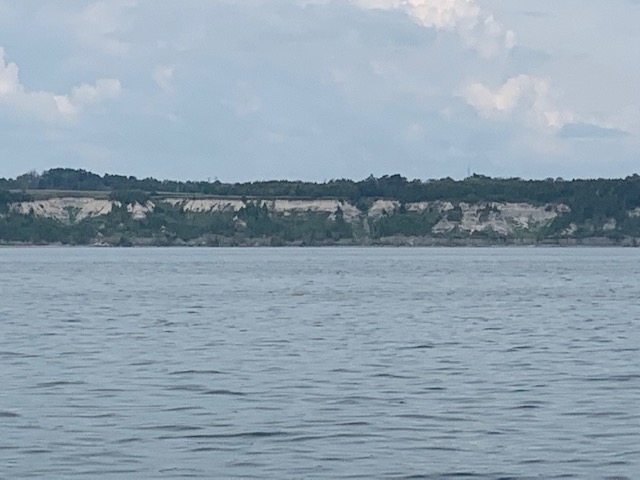
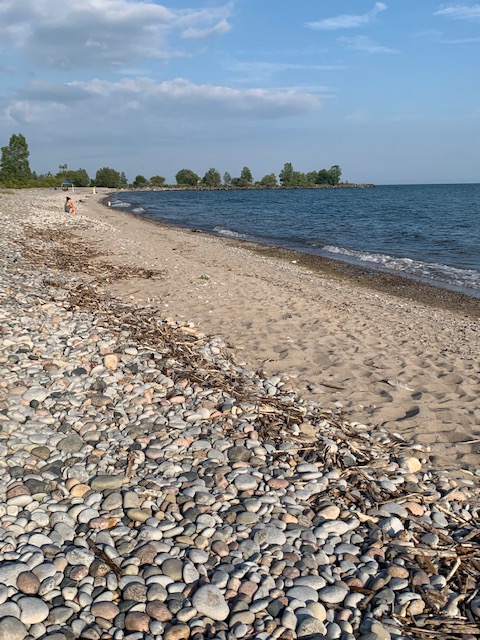
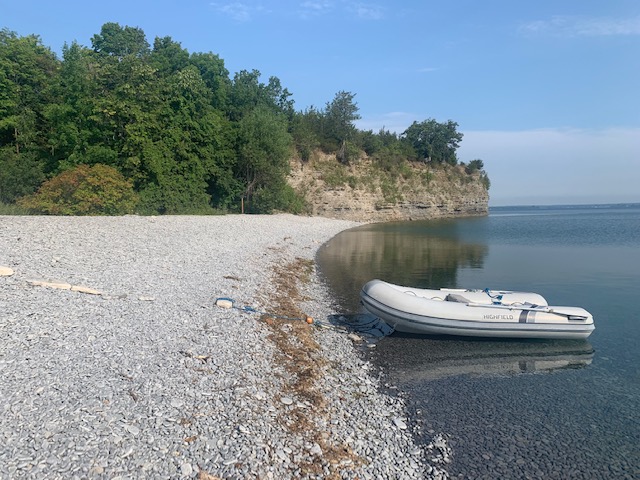
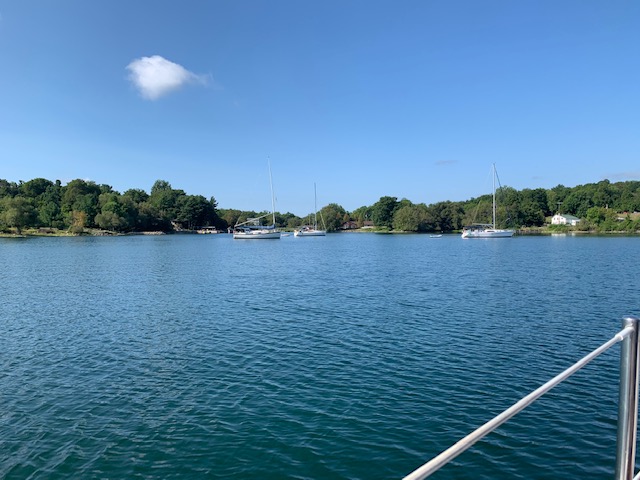
After a quiet night and a short pebble beach/cliff walk, we continued moving NE towards Kerr Bay on Amherst Island, one of the anchorages recommended by Esmeralda.  We ducked into the marina at Bath for ice, of course, only to find they were out of blocks. Geez!  While Fred topped off the diesel, Lisa scored a new primer bulb for the dinghy fuel line from the mechanic, hoping that might solve the issue (nope).  Kerr Bay was just a quick two-mile jump across the channel, and we anchored behind 4 boats already there.  What a pretty spot!  There were only a few houses at the head of the bay, and the water was clear and warm.  Swimming was great and we enjoyed two days here. 

With looming rain storms and strong north winds forecasted (bad for Kerr Bay), we moved across the North Channel to Collins Bay Marina.  After topping off the ice (only crushed…) we biked up to the grocery store. Lack of refrigeration also means more frequent trips for fresh items!  The next morning we dinghied across the channel to a boat ramp and walked to another marine supply store – this time for a water pump they had in stock.  Our deck-wash pump had cracked (oh – so THAT’S where the water in the bilge was coming from!).  This pump pulls water from the lake and exits at a hose bib on the bow – allowing us to wash the crud and mud off the anchor before it gets all over the deck, or alternatively, to wash the deck without tapping into our freshwater reserve.

As we exited the marina for Kingston, we tried to top off the ice. They were completely out! Apparently there is only one ice company that serves the entire Kingston area, and no one had heard from them in a week, despite repeated calls.  We called ahead to several other marinas and got the same story.

We had heard nice things about Confederation Basin Marina and the city of Kingston, but all dockspace was booked for the next several days, in part due to the weekend BluesFest and charity boat races.  NE winds meant the next best anchorages were past this city.  As we cruised by the Kingston Yacht Club on the coast at the foot of downtown, we called in just to see if they had a spot.  Eureka – they had one guest spot!  Unfortunately, as we tied up to the end of the very exposed t-dock, we had to think hard about actually staying.  It promised a rolling, creaky night.  We decided to pay the price of losing a good night’s sleep rather than miss a visit to Kingston.

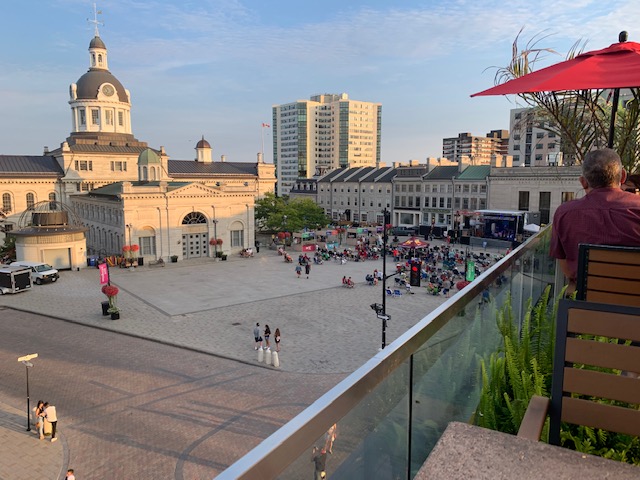
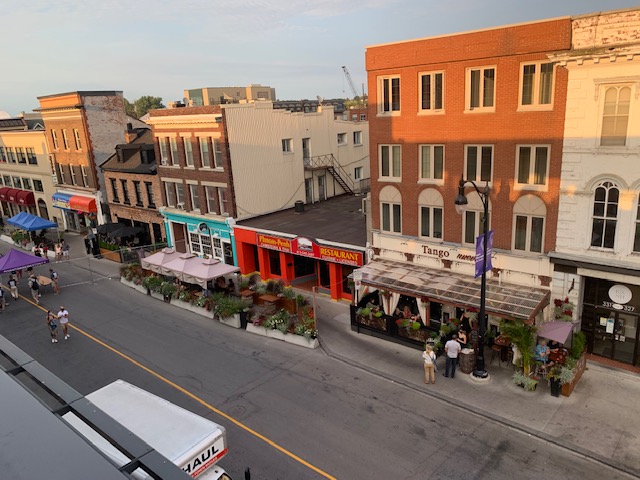
Downtown was only a few blocks up the road, and we passed some beautiful old buildings dating back to the early 1800’s.  Known as the Limestone City, most of the official buildings were constructed with this material.  We had dinner at a rooftop restaurant that overlooked City Hall square, where they were setting up for the evening Blues Fest.  It was hard to choose a restaurant – the streets were lined with romantic sidewalk patios and there were so many choices! We joined the music crowd after dinner, but with a fall chill in the air, and without jackets, it eventually became too cold to sit there, and we returned to the boat for what was indeed an uncomfortable night.

The yacht club had been out of ice for a week, but we had called the closest convenience store and they set aside 6 of the 10 bags they had left.  First thing in the morning we dinghied over to the boat basin and picked up that ice (crushed…), then set out to see more of the Thousand Islands. 

We passed historic Ft. Henry, built on the heels of the War of 1812 to protect the British naval dockyards, and were sorry we did not get to visit. There is so much history related to the early settlement and strategic control of this region, and there are reminders everywhere.

We rounded the north shore of Wolfe Island on our way to Brakey Bay.  Wolfe is the largest of the Thousand Islands, mostly low lying and agricultural, and known for having an impressive wind farm – 81 windmills dot the horizon.  The bay was toward the east end of the channel, and well protected from the strong south winds in the forecast. We set anchor near the head of the bay in 10 feet of water.  This was another beautifully wooded shore, and although there were houses, they were set back and hidden by the trees.  We stayed here 3 days, relaxing and tinkering, ordering parts (new fridge!), installing the new deck wash pump, and watching other boats come and go, until the last of the ice was gone, forcing us back to reality and timelines.  We were notified that the Oswego Canal was set to open on September 3, and we needed to get back to the states and (finally) into the canal system.

Fair Winds, Fred and Lisa
Lake Ontario – or, Canada finally let us in!

We had a nice sail straight across Lake Erie to Port Colborne, Ontario. In order to enter Canada, we had to complete an ArriveCan form online, with photos of our passports and vaccination cards, and phone in upon arrival. In addition, we had to have proof of negative covid tests within the past 72 hours.  We tied to the guest dock and the marina staff informed us that the Border Report phone was out of order.  Thank goodness our phone plan has calling for Canada and Mexico!  It took a while to connect to the right 800 number, but we finally got an agent, who said he couldn’t see our vaccination cards, and we would need to update the file online before he could help us. (At this point Fred’s patience level gave out, and Lisa took over). He was nice enough to keep us on hold, and checked back a couple times until we had things resubmitted. After the usual border questions – Any fruit/veggies? Guns? Fireworks? Currency over $10,000 (hahahaha – sure.); he noticed that Fred’s vaccine card was missing the date and lot info for his first shot. The sticker was completely blank! Not sure how we missed that, but since he had his second shot, and his card was basically the same as Lisa’s, the agent let it go with a warning to get it corrected. We will see if this causes more problems down the road! The Canadians are taking covid very seriously, and masks must be worn if one is indoors – vaccination or not, even though Canada now has a higher % of vaccinated folks than the U.S.  Many people wear them outside as well.

We spent the next day getting situated for our transfer through the Welland Canal north to Lake Ontario.  The dinghy, which we tow when moving short distances, was put up on the foredeck and we went to explore a bit. This was a very nice marina and town was a short walk away.  We biked to the small boat staging area on the canal to see where we would be starting in the morning, had a great lunch at the Canalside Restaurant, and made stops at the grocery store and LCBO (Liquor Control Board of Ontario). All alcoholic beverage sales are done through the province. The liquor store sells everything, but beer choices are limited, and there is also a shop called The Beer Store. Canadian alcohol is expensive compared to the States, with a 12 pack of basic beer beginning around $25.  Oh well, priorities.

We had pre-registered and paid online ($200.00 CA) for our down-bound transit of the 28-mile long Welland Canal, which gets one around Niagara Falls. We reported to the staging area on the south end of the canal before the 7 am start time. There were five private boats making the trek – one huge racing sailboat with its mast down (“OC 86”, an 86-footer owned by famous sailor Dawn Riley, was first to finish the Chicago-Mac race this summer), one large cabin cruiser, and 3 sailboats (us included). In the locks, the larger boats tie to the wall and handle the lines, with smaller boats rafted to them, so our order was OC 86 alone, followed by the cruiser with one sailboat rafted, and us, with the smallest sailboat rafted. So, we worked, and the guy rafted to us actually fell asleep in the last lock!  With OC 86 taking the first 100 feet of the lock, we were right up behind that cruiser, sucking the exhaust, because we couldn’t block the freighter pads (giant suction pads that actually grab the side of the freighter, so they don’t use the lines). In the last 4 locks, they finally let us stay behind the pads – much better! There are a series of 8 locks, averaging a 50 foot drop each, mixed with some longer motoring passages. There are also several lift bridges that require opening, so it is a day of “hurry up and wait”.  We left the last lock at 5:15 pm and tied to the guest dock wall for the evening. We had only passed two freighters, both upbound.  Small boats must wait for commercial traffic locking in the same direction, so we were lucky. We have heard stories of people waiting for several hours!

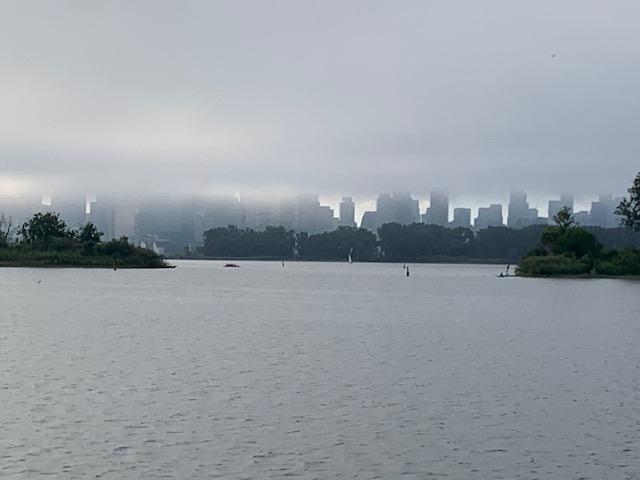
After a quiet night on the wall, we left early to try and beat the rain forecast.  Lake Ontario was flat with a very light breeze, and we motored north in the drizzle to Toronto.  Ritual’s cockpit is protected with a dodger and bimini, which keeps us fairly dry, and we have side curtains we zip on for those really nasty or cold days. Due to the haze and mist, we arrived at the outer harbor and were disappointed that we still could not see the skyline! 

Toronto is surrounded by a set of islands to the south, and a large peninsula to the southeast.  We followed the channel east to the Outer Harbour Marina to buy ice (really starting to miss that fridge), and were thrilled to find they had blocks! Surprisingly to us, up to this point all bagged ice had been crushed or cubed, and they don’t last more than day or two. 

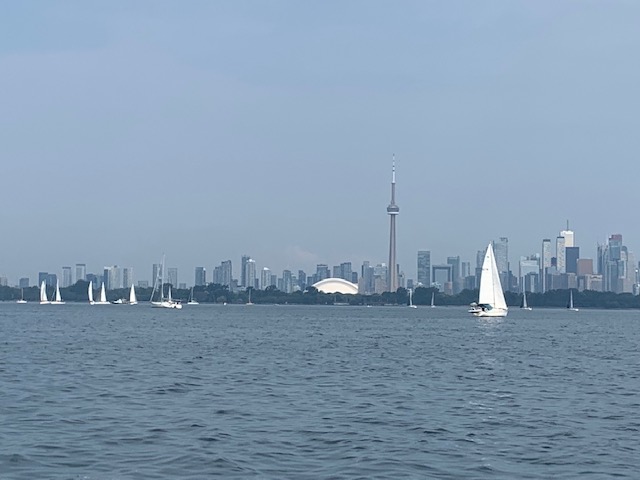
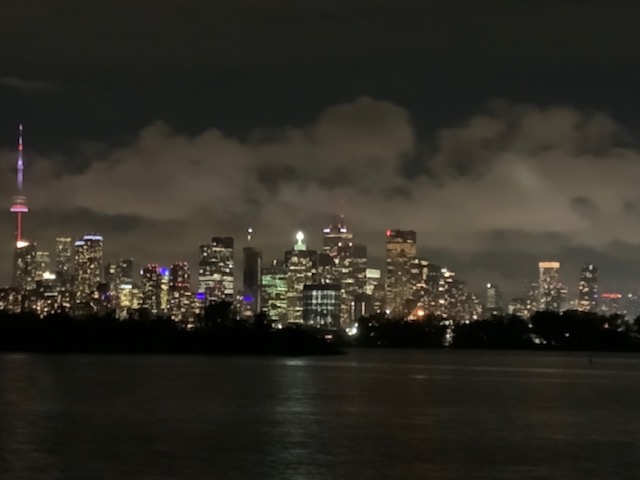
We returned out the channel to anchor in a small bay occupied by the Aquatic Park Yacht Club. They have 100 mooring balls and guests are allowed to use the few empty ones, but we couldn’t raise anyone on the radio or phone, so we anchored in the area marked for such on the chart.  We dinghied up to the clubhouse, but it was locked up tight with covid signs on the doors.  This is the most “rustic” yacht club we have visited, and suspect the members pride themselves on that!  What an awesome, protected spot, surrounded by a huge park with lots of birds and an incredible view of the Toronto skyline, which finally began to show itself as the afternoon sun slowly burned the mist away.

Just as we got comfortable, a guy zipped over in his dinghy to tell us anchoring is no longer allowed, and we might get hassled by the Toronto police.  Apparently they have had problems with boats rafting together and partying ‘till all hours.  It seemed like a pretty quiet Wednesday evening, even with the few club boats that were headed out for a race, so we decided to take our chances. It seemed unlikely that the Toronto cops would bother to look for us – one quiet sailboat tucked behind 100 others!

We spent the rest of the afternoon cleaning the dinghy bottom, which had developed an interesting web of some kind of growth, and washing the canal lock crud and mud off the hull and fenders. The water was clear and warm and a welcome change from Lake Erie. Two small boats came in and anchored for a swim but did not stay.  By dusk, one other sailboat had settled in.  We stayed in the cockpit until late, watching the lights of the city come on, and very happy to be in this place.

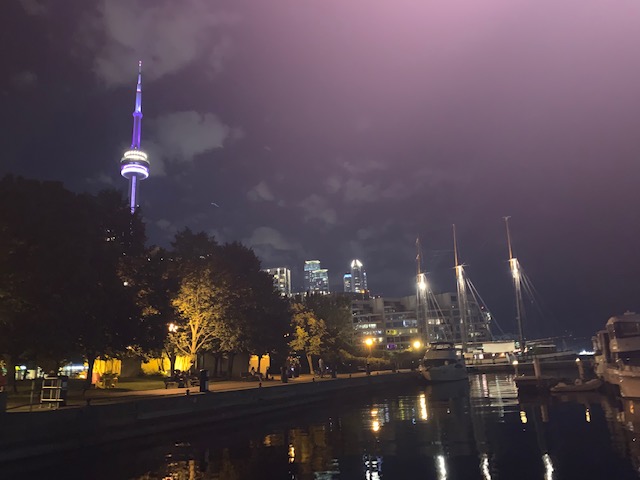
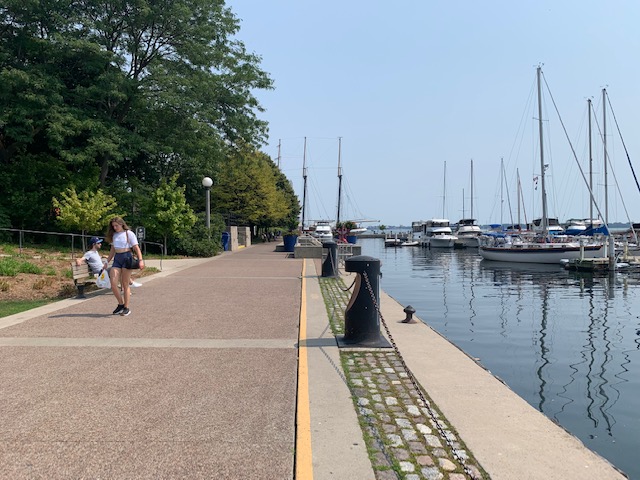
Toronto has a few marinas right along the city shore, and several out in the islands.  After striking out at a few of the island places, we scored a city slip in the Marina Quay West, right in front of the Music Garden near the foot of Spadina Ave, giving us great access to a few of our favorite city spots.  Ritual was directly across from the promenade, and it was fun to watch the “parade” along the walkway.  We found a great Japanese restaurant (Guirei) across the street; took the bus up Spadina Ave. to the Chinese District, where we visited the new T and T Asian Grocery on its opening day (crazy busy and couldn’t understand much!) and the Kensington Market area (so many cultures!); ate more sushi, walked the waterfront, wore out our feet, and wished we had more time (and $) to spend here.  We were sad that the normal Harbourfront Centre concerts in the park were all virtual due to covid, and yet, reminded of how much we appreciate urban landscapes and the cultural opportunities offered.

Seeing a good weather window, we left on Saturday for our trek along the northern coast of Lake Ontario toward the Thousand Islands area of the St. Lawrence Seaway.

Fair winds!  Fred and Lisa
S/he who hesitates is…stuck in Lake Erie

So – it has been over 2 weeks since our last post, and we finally left the south side of Lake Erie.  The key word for us has been “logistics”.

We left Sandusky on a quiet morning, motoring out the bay through the marked channel, past Cedar Point and its multiple roller coaster skeletons. (Lisa to Fred – “Are you sure you don’t want to spend one day at Cedar Point?”  Fred – “Never been more sure.”)  Then we dodged all the morning fishing boats.  We set a course for Cleveland, about 40 miles up the coast.  Just as we began to relax into the rhythm of wind and waves, an orange flagged buoy appeared just off our side.  Crap – fishing nets!  Ohio regulations state that one should “go around” trap nets.  They are supposed to be clearly marked with a single orange flag at the shore end and double flag at the offshore end.  Then there are small buoys marking the trap supports in the middle.  Too late for us to turn the boat – so we gritted our teeth and crept across.  We know that in Michigan boats can cross over these nets if they avoid the buoys, since the trap is sunk deeper below the surface.  Not sure about these, but nothing seemed to be dragging behind us as we continued on our way! We spotted several more trap flags along the way, managing to steer clear.  The hardest part was distinguishing from the little white buoys (seagulls), which line up as if they are marking a net, and keep us on our toes.

Cleveland has a harbor stretching 5 miles along its waterfront.  We found a slip a the 55th St. Marina Basin on the far eastern end and tied to the outer end of B dock.  We were promptly welcomed by the neighboring boat owner. We found a nice patio restaurant next to the marina office and enjoyed great fresh Lake Erie walleye and perch!  That evening the B dock folks hosted a live band and invited us to join in. Sunday brought round 2 of thunderstorms, and we were (again) happy to be in a sheltered spot. We spent the day calling Buffalo, NY to line up the dropping of our mast for entrance into the Erie Canal. In our past research, there used to be at least 4 places that offered this service.  Now, 2 said our mast was too big for their equipment, 1 no longer offers this service, and the final one said sure – they could see us on August 24th – 3+ weeks away! They were the most expensive and also discouraging about having mast support cradles available. (Many people leave their structures behind when they enter or exit the Erie Canal). Rumor had it that the Canadian border was to open to vaccinated Americans on August 9, so the Welland Canal in Ontario became our “plan B”.

We departed Cleveland in rolling seas and motor-sailed east.  Raising the sails helps smooth out the ride, and the engine does a lot less work. The weather calmed as we arrived at Geneva State Park in the early afternoon.  What a lovely park and marina! The guest dock is protected from the lake by a small hill, and was empty except for us and another sailboat. There is a small store and marina office that even offered breakfast.  We were surprised to see several Amish folk coming and going in small fishing boats. There is a large population in Ashtabula County.  Across the harbor entrance was a huge beach area, and bike trails connected it all with the adjacent small vacation town – Geneva on the Lake.   We biked over the town the next day.  GOTL, as the locals call it, consists of “the strip” with many small cottages, a big lodge/resort on the lake, and a row of arcade places, restaurants and a few gift shops – not that appealing to us. We are finding that on Mondays and Tuesdays many places are closed, as was the case with the High Tide Tavern (sounded like our kind of place), so we settled for the Firehouse Restaurant and Winery, which had a lovely patio in a park-like setting overlooking the lake, and quite possibly, the worst nachos ever. We think they used Cheez Whiz.

Erie, PA was our next stop.  The Erie Yacht Club was established in 1895 and came highly recommended so we took a slip for 3 days (2nd night free 😊). We had arranged for a rental car (Enterprise will pick you up…) to reprovision, do laundry and possibly get covid tests in case the Canadian border opens. Our timing was not so great as we arrived just before the start of Wednesday night club races.  We managed to dodge all the boats going to and fro (who sets a starting line right in front of the harbor entrance?!) and tied to the guest dock in front of the clubhouse.  As we passed down the fairway, it was nice to hear many people holler welcome.

What a lovely club!  The club sits at the base of a cliff, and the road out is up a steep ravine. The clubhouse has photos from its earliest days, including women sailing in their big hats and long dresses at the turn of the century. We enjoyed the guest dock, restaurant and bar. But it is still an “old-school” club – the past commodore photos consist of 100+ years of white guys. None the less, the property supports 400 slips, several buildings, a youth sailing program, and beautiful restaurant and bar.

There was another Traverse City yacht, Manitou, anchored at the state park, so the next day we picked up Liz to go grocery shopping.  So fun to see folks from home!  They were headed to Buffalo the next day to prep for the Erie Canal.  We were in a quandry about heading to Buffalo or waiting for Canada to open, so decided to stay put and see how things unfolded. We did not want to spend 2+ weeks sitting in Buffalo waiting to drop our mast, plus there was another round of thunderstorms predicted for the coming week. We made the best out of having a car, and visited the Erie waterfront and the Hagen History Center.  The center was wonderful, with a Frank Lloyd Wright display, including his cars and office from San Francisco, and a historical 19th century brownstone mansion that was reminiscent of a lumber baron’s home in Lisa’s hometown of Muskegon, MI, but even more opulent.

We left the EYC for the Presque Isle State Park harbor, where Manitou had been.  Presque Isle is a huge peninsular park that encompasses all of Erie Bay. The harbor is a man-made lake with a small marina that is completely protected from all directions. We anchored out in the SW corner to ride out whatever weather was coming our way. Did we mention that the water here comes with a warning for dangerous algae?  It’s a bit off-putting, but it was really hot (85 degrees) and all the folks anchored out were swimming in this lake. Not seeing anything alarming floating around us, we finally jumped in too.  Such a wonderful relief – but Lisa laid awake at night worrying if we had contracted anything, with her mom’s voice echoing “if all your friends jumped off a cliff, would you?”  Guess so mom.

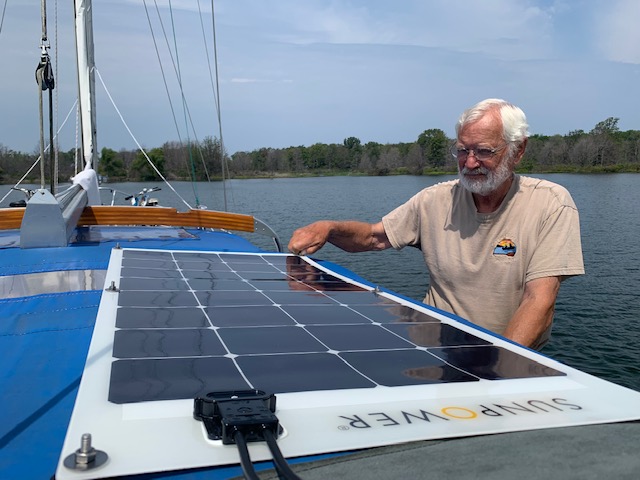
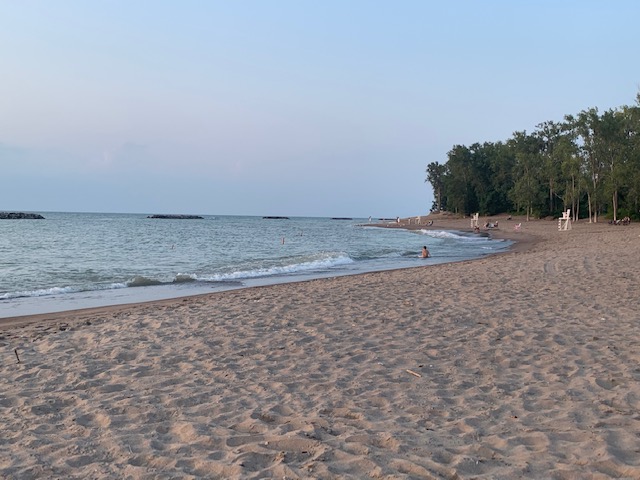
We spent 3 days at the park.  Rain came and went. We installed 2 of our solar panels on the bimini. We walked a few of the outer beaches, and watched herons and kingfishers, geese and ducks. The outer beaches stretch for miles. Its a grittier sand than our Lake Michigan sugar sands, with life guards, short break walls, concessions and bath houses. The huge parking lots attest to their popularity.

Several thunderstorms trained through, the last one bringing 50 mph winds with the front, and one lightning strike that was way too close!  You know how you count 1000 one, etc to see how far away the strike is?  We didn’t get to 1000.  The next morning our refrigerator pump did not work. Yes, it is old, but was functioning well – so, blasted.  Now we had an ice box.  One nice surprise was a free head pump out with the purchase of diesel, so we topped off our tank. Pump outs are required in the Great Lakes, and charges vary from $5 to $20, so free was great. We were beginning to get a bit anxious about moving on, knowing at least 2 boats who had gotten their masts dropped and were already on their way down the Erie Canal while we sat in place.  It was hard to shake the mentality that somehow they were “winning”.

Good news! On Aug. 9th, Canada announced that small boats would be allowed to enter!  Previously, entry had been announced only for land or air.  We decided to transit the Welland Canal in Ontario, tour a bit of the Canadian shore in Lake Ontario, then proceed to the Oswego, NY canal, and enter the Erie Canal from there. We headed back to the Erie Yacht Club (another twofer deal!) to arrange for our covid tests, which must be within 72 hours of entry.  Turns out that the drug stores in Erie were now out of the quick covid tests, so we rented another car and drove 45 miles to the Meadville, PA Walgreens to score the last 2 “quickie” tests available. Done, and negative. Yay! We were beginning to joke that we should just join the EYC, because it seemed we were never leaving.

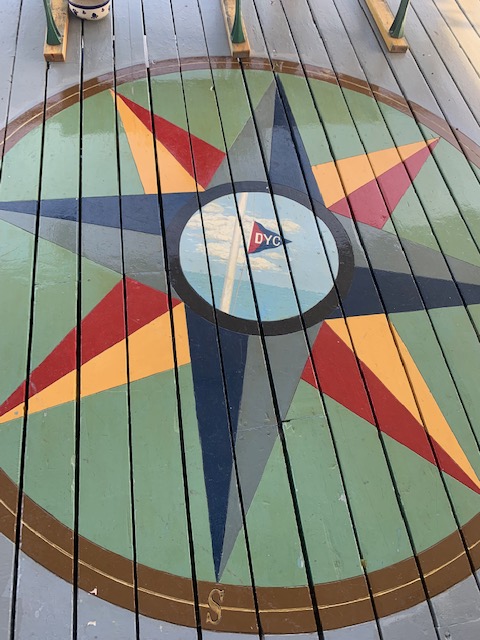
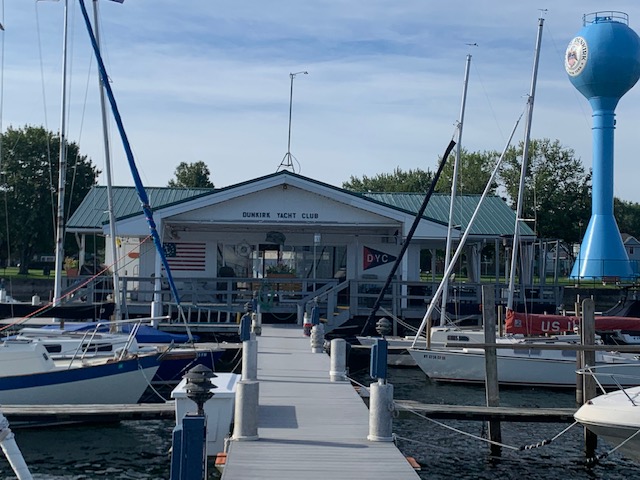
Finally with a plan we were comfortable with, we left Erie. A quick stop at the very friendly Dunkirk, NY Yacht Club would set us up for the 25 mile run across Lake Erie to Port Colborne, Ontario and the transit through the Welland Canal to Lake Ontario. And we lucked out with another live musician on the dock that night!

A s we write this, we are tied up across from the promenade in downtown Toronto, stomachs full of fantastic Japanese food, enjoying a glass of wine and watching the parade of people in the park.  And feeling more like winners!

Into the Erie

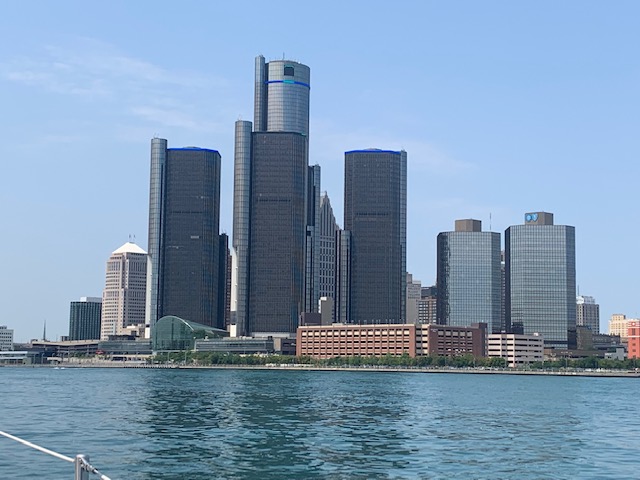
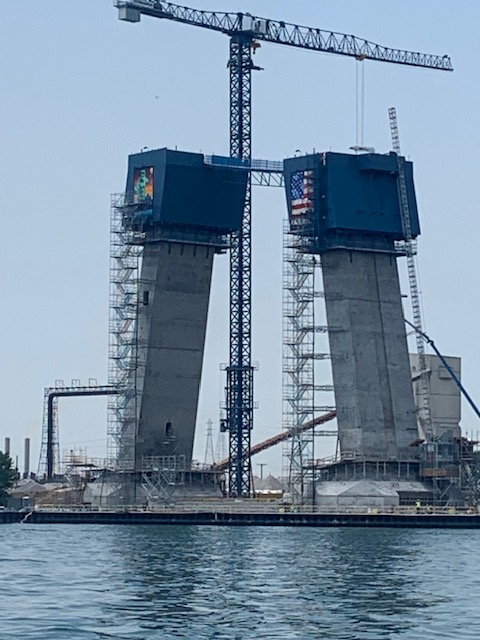
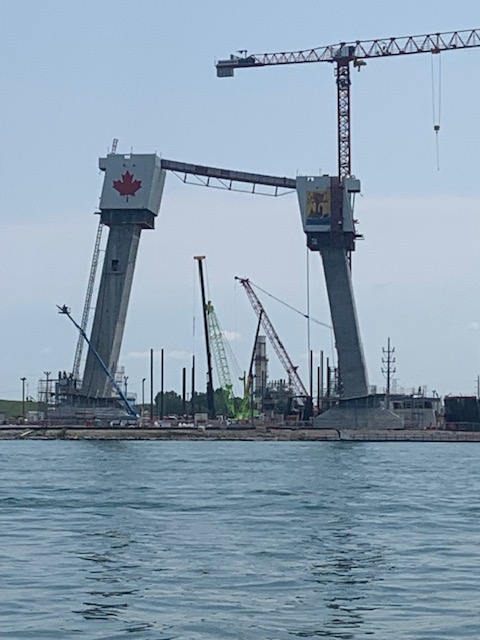
As we left Lake St. Clair, everything became new to us. It felt like the adventure was really beginning! We passed the “Ren Cen” and downtown Detroit, then crossed under the Ambassador Bridge. The new bridge abutments were being constructed south of there near Zug Island. The rusted out, ginormous industrial site will not add to the views from the new bridge. It was an overcast day, and I guess we need a blue camera filter.

We had selected the Gross Ile Yacht Club at the SE corner of Gross Ile as our overnight stop. Our other choice was the Ford YC on the SW corner. Both came highly recommended, and both had very shallow entrances, so we went with the less formal club and more direct route of GIYC.

If you are wondering “why stay at yacht clubs?”, many clubs offer reciprocal membership privileges. As members of the Grand Traverse Yacht Club, we can stay and use the premises of our sister clubs. Some offer free dockage, but we have yet to encounter this perc, although we have had reduced rates vs. marinas. The GIYC is small, and the only place to tie up is along the front dock, but the restaurant came highly recommended, and the channel looked more negotiable than the one to Ford YC.

We followed the Livingstone Channel south, and ditched west out the “hole in the wall” – literally a hole in the seawall. We wished we could have gone east to a small anchorage but it was in Canada – border closed due to Covid – and the Canadian Coasties were actually patrolling as we passed. As we approached the dock at GIYC, the current became quite evident, and our stern was swept into the dock’s end piling. The dock master was yelling “Out, out!”, which Lisa took to mean “Get out of our marina!”. There was no getting out, with our full keel preventing quick turns and the current pushing in, and Lisa is yelling back “but we called in and you said okay!”. The club manager Sandy appeared and quickly cleared things up. We finally got tied up and all seemed fine. We had a lovely dinner, and even received a complimentary appetizer.
The dock is protected from all winds – except from the south. The forecast, for NNE winds, seemed accurate, but overnight it moved south and we found ourselves rocking and rolling with docklines straining as the waves passed under the dock and (luckily) pushed us away. We couldn’t wait to get off that dock in the morning! We followed the shallow marked channel south until we finally entered Lake Erie and depths above 12 feet, and set our course for the islands. Twenty-five miles later, we dropped the hook on the north side of Middle Bass Island near the State Wildlife preserve. Ahhhh.

The bottom was rocky and we could feel the anchor as it pulled along. Fred pulled it up and it was actually a lot of clay, full of smaller rocks. We reset the anchor and it seemed to hold fast. We run a 55 lb. rocna anchor, and once set, we rarely worry – or move. It felt great to be sitting in this small bay, with only a few houses, lots of birds to watch, and a water temp of 80 degrees!! After a gorgeous sunset, we had a wonderfully quiet sleep.

We spent a lazy day exploring. There was a tiny beach along the wildlife preserve, but with many trees having fallen in the water, difficult to walk. A water snake climbed out on one trunk, so we decided not to swim there! We had been warned about the snakes sunning themselves on boat transoms, and were glad for Ritual’s high sides. We dinghied over to the beach on North Bass Island and had a nice walk and swim. There was sand here, but mostly small stones, clam shells and a few pieces of sea glass. Lisa has a compulsion to pick these things up – but to keep where?? (note: I only kept a few, very small ones! – LKW) As we got the dinghy off the beach to return to Ritual, a snake swam by.
That evening, a strong line of thunderstorms moved through. We heard that TC had a flash flood warning from the same system. We battened down the hatches – literally; made sure we had an anchor alarm set, and waited. Why does it seem they always hit in the middle of the night? For awhile, the only time we could see shore was when there was lightening, but we had that in abundance. Our faith in the rocna was upheld – we did not move.

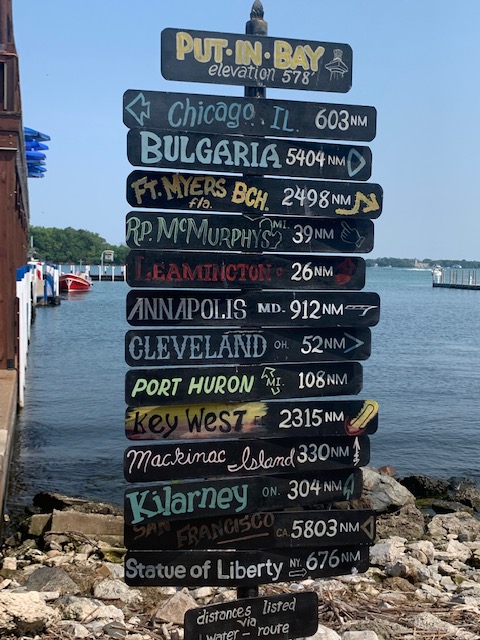
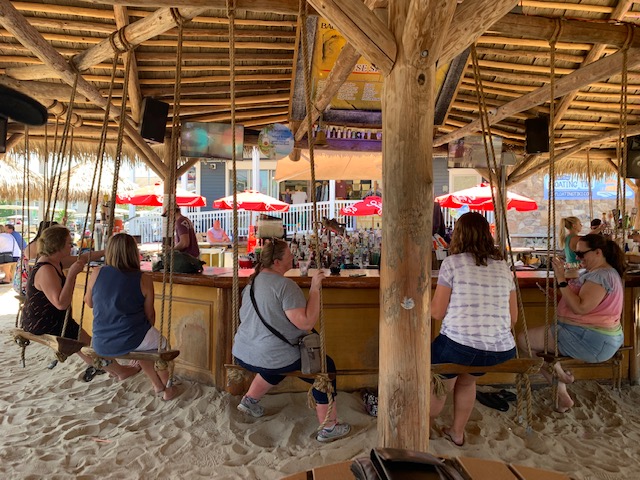
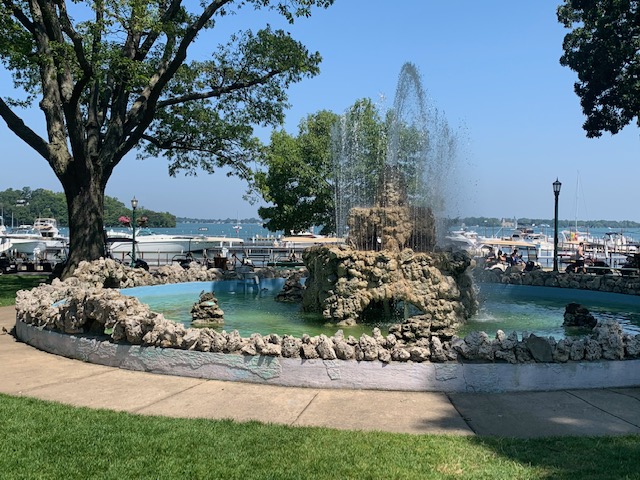
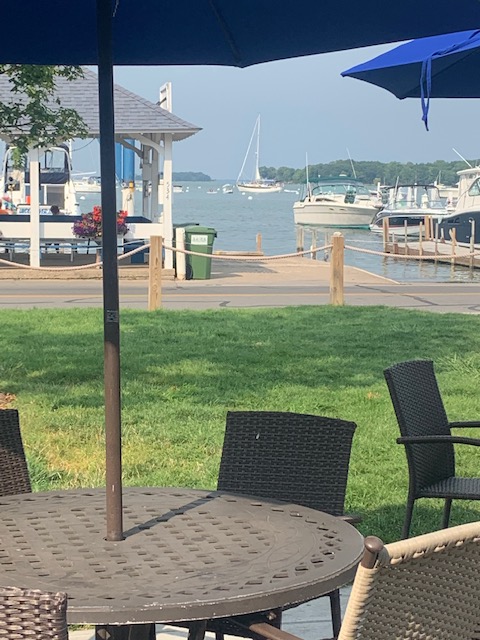
We had purposely waited until Monday to head over to Put in Bay, so the weekend crowd could thin out. We hooked a mooring ball (one of 80!) in front of the Boardwalk, and once settled in, called the water taxi for a trip ashore. We heard stories about PIB being Mac Island on steriods – it is really Mac Island with golf carts – zillions of them. We walked the main block along the bay, checking out some of the options for food/drinks/shopping, and had a drink at Mojito Bay – a outdoor bar with a sandy floor and swings at the bar. Someone needs to do this in TC!

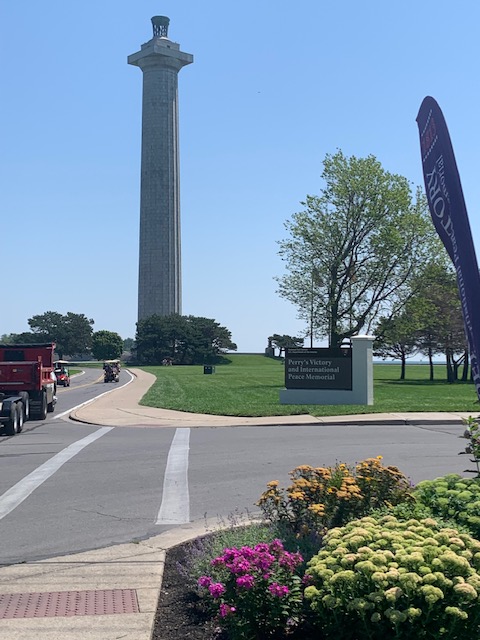
Since our bikes appeared likely to be run over by golf carts, we opted to join the crowd. We spent the next day tooling around the island from one end to the other. A highlight would be the elevator trip up the 352′ Perry monument, commemorating Cmdre. Perry’s victory over the English in the war of 1812, and the ensuing years of peace with Canada. This is part of the National Park System and the Visitors Center was nicely done. We enjoyed a fine perch dinner on the PIB Yacht Club’s patio. I know – another club – but it was so pleasant, without the crowds or loud music emanating from the other establishments. I guess we really are getting old (or smart?!).

Every evening the Boardwalk – this big conglomerate of restaurants/bars/shopping that sits at the heart of the bay where the water taxi lands – holds a flag ceremony. They broadcast the Star Spangled Banner while they lower the big flag on the dock. I think the music in the bars actually paused. We watched a mooring ball neighbor solemnly pull their flag from its holder and slowly roll it up to the music. It reminded us of the ceremony they used to do in Roche Harbor in the San Juan Islands, but I think they played Taps. We were also treated to wonderful fireworks from the ferry dock on Monday night, for an unknown reason, since it did not happen again.

With a dire forecast of front line thunderstorms, including a possible direcho, we moved to the Sandusky Harbor Marina on the mainland. Nice pool, and free laundry! We had a lovely afternoon, and were quite glad to be tied to a dock when the storm rolled through – again in the wee hours. No direcho, but 40 mph winds was enough. The wifi connection is great – hence all these blog updates at once. Oh – and there is a water snake sunning itself on one of the jet ski ramps. Lisa asked a man nearby if they were aggressive. He said they are not poisonous, but they do bite, and then they chew. Great. His 2 little girls grabbed a net to go mess with it. For fun, google the TV show Dirty Jobs – the Lake Erie Watersnake.
Good news from the Erie Canal – the lock holding us up has now opened for travel! We will spend the next several days working our way east along the Ohio/Pennsylvania/New York shore to Buffalo.

Till next time, Fred and Lisa